The Scholar’s Golem

Shakespeare1

I’m back! Saturday I finished and turned in the last paper for my last class. What a relief! I now hold, for better or worse, a master’s degree in Humanities. It was a tough road, one I’d gladly take again but am very grateful the journey has ended. A new one begins. Now I can truly call myself a scholar.

For my Twitter followers who may wonder why I call myself @armchairscholar it’s because I got my degree online from The University of N. Carolina at Greensboro (go Spartans!). It is play on the old term for those who sat home and read scholarly works.

So, now that I’m a scholar, let’s talk about them. More specifically, let’s talk about Shakespearean scholars.

Matthew Lyons, a wonderful historian posed an interesting question on a blog post titled, Who’s to blame for the Shakespeare authorship controversy? The post argues that Shakespearean scholars who use conjecture as their basis of fact are not better than the anti-Stratfordians who use similar methods when arguing their points. Both sides of the authorship controversy plea special knowledge and insight into the truth, yet in doing so offer little more than speculation and well argued guesswork.

It’s a great post and gets right to the heart of the matter with Desmond McCarthy’s wonderful quote about Shakespearean biography:

Trying to discern Shakespeare’s personality, McCarthy said, is like looking at a portrait set behind darkened glass in a gallery. At first the portrait seems flat and lifeless. But the more intently you regard it, the more the sitter’s features seem to come to life: eyes at first dull now spark and gleam; the solid brushstrokes around the jaw soften, melt to flesh; the mouth parts, as if exhaling a long-held breath. Only then do you realize that it is, in fact, your own face you are admiring, reflected in the glass.

See, this is the problem with many Shakespearean scholars. They are intent on breathing life into the man but only end up with a Golem: a soulless creature that is alive through the scholar’s own written word. This Golem ends up behaving in ways in which scholars envision him and we are no closer to knowing the real man, despite the many words written about him.

You would think, after so much time and effort there would be no stone left unturned in the archeological digs for Shakespeare’s life, but you would be wrong.

Terri Bourus, an associate drama teacher (yes a drama teacher, no less) has written a book titled, “Young Shakespeare’s young Hamlet” in which she tries to solve the “mystery” surrounding the first printed version of Hamlet. While her argument for a young Shakespeare writing and then re-writing Hamlet as he aged, may have merit, but her excitement over her ability to “to discuss the personal relationship between Shakespeare and his friend and longtime colleague Richard Burbage” is suspect. How did Bourus come to such a conclusion? What, did she find that others had not?

Not much according the reviews (and there are not much in the way of reviews). Once again we have someone who has dazzled a few with a circular argument; the times and plays inform us about Shakespeare, who in turn, informs us about the plays. All this from her conclusion that the printers were key to learning about Shakespeare.

After all, without the printing houses, we would not have Shakespeare’s plays today,” Bourus said. “Shakespeare’s plays come down to us, not only on the stage, but primarily from the page.” Who can argue with that logic?

Scholars are supposed to come up with facts. Oh how I wish Bourus had come up with facts! Letters, diary entries, anything that proved a young Shakespeare first worked on Hamlet; proof of knowledge about the personal relationship between Shakespeare and Burbage. But alas, she has not. All we have is her personal Golem and more fodder for the anti-Stratfordians.
http://news.iupui.edu/releases/2014/11/hamlet-young.shtml

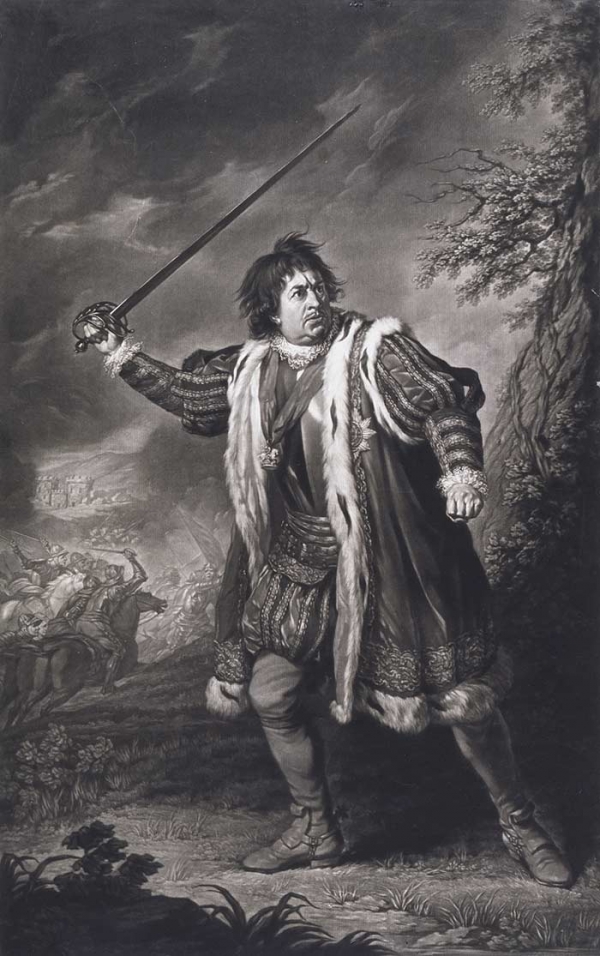
David Garrick & the fall of bombastic acting

Garrick as Richard III

When you think of great Shakespearean actors, who comes to mind? I think of Kenneth Branagh, James Earl Jones (is there a better Lear?), Lawrence Olivier, Helen Mirren and Tom Huddleston. Each of these actors, when on stage, becomes the character they play. We are pulled into the drama precisely because of this. Modern audiences are accustomed to players who bring fiction to life; we would be disappointed by actors who just recited lines. There a term for this type of acting, “phoning it in”. “Hamming it up” is a derogatory term we use for those who do the opposite by overacting with exaggerated body language and lines. But, would you be surprised to learn this wasn’t always the case? Prior to 1740, this type of acting was the norm.

Jack Lynch, author of Becoming Shakespeare, offers readers a look into the history of how Shakespeare came to be regarded as the world’s greatest playwright. Lynch introduces us to the people behind the making of Shakespeare into the Bard we know and love today.

An interesting part of this story is the history of the theater and those who acted in it. We are introduced to several colorful characters whose popularity helped fuel the desire for Shakespeare’s work long after he created them.

One of these colorful characters was David Garrick, the first Shakespearean superstar. Garrick’s rise to fame was a result of his break with contemporary acting. Garrick would change audience expectations, and forever change what would be considered “acting”.

Before Garrick, actors were bombastic and flamboyant in both speech and mannerism. Acting was nothing more than reciting lines as loudly as possible with exaggerated body language. This was due in part because they had to carry their voices across the theater, and partly because being bombastic was considered “acting”. It never occurred to anyone to do anything else.


Garrick as Hamlet
Garrick as Hamlet

Garrick arrived on the London stage scene in 1740, having failed in his family’s wine trade. Garrick knew he was no businessman, and had always fantasized about acting. The Goodman’s Fields Theater in London gave him a chance; what we would term an “off-Broadway” theater company today. Garrick was given the star role in Richard III and was an instant hit, or at least, an instant sensation, as his unconventional methods would prove to be controversial.

Garrick abandoned traditional acting methods mentioned above. Instead, he appeared to feel the emotions he was portraying. One contemporary said of his style. “He is the only man on any stage where I have been, who speaks tragedy true and natural”. This “natural” approach to acting would revolutionize London’s theaters forever.

Not all audience members however appreciated this new style. Many felt Garrick was no “actor” and thought him a disservice to the theater. Henry Fielding satirized the uproar in a very funny scene in he novel Tom Jones. In the scene, Jones takes his servant Partridge to see Hamlet. Partridge having never been to the theater, mistakes Hamlet’s reaction to his father’s ghost as a real emotion. Later, when asked about the actor playing Hamlet, Partridge replies, “He’s the best player?! Why I could act as well as he myself. I am sure if I had seen a ghost, I should have looked in the same manner, and done just as he did”. Partridge points out that the King, a more bombastic player was the real actor on stage.

Thankfully the majority of theatergoers did not agree with Partridge’s sentiments. Garrick won over audiences and because of him we expect our actors to be natural. Garrick and his successors would bring new life into Shakespeare and helped created the emotional Shakespearean tone we know today.


For the fun of it.

In the course of a conversation this week with Professor Rosenblum, a noted Shakespearean scholar at the University of North Carolina, the subject of bombastic acting came up. Professor Rosenblum asked me if I had seen an episode of the Blackadder, in which two Shakespearean actors give the prince “acting “lessons. I had not, but eagerly sought it out after being told the episode makes fun of the bombastic style of acting and mentions Garrick. I found this clip, though the sound quality is poor, headphones may be required, so that you my dear readers can see just how far we have come thanks to Garrick and his “natural” style of acting.


Henry Fielding, Tom Jones

Jack Lynch, Becoming Shakespeare

Amazing Waste

Repurposing Food and Reducing Waste

measurestillformeasure

Shakespeare, Classics, Theatre, Thoughts

Nerd Cactus

Quirky Intellect for the Discerning Nerd

Sillyverse

Stories of magic and mystery

Commonplace Fun Facts

Mind-Blowing Facts You Didn’t Know

Fictionophile

Fiction reviews, Bookblogger, Fiction book reviews, books, crime fiction, author interviews, mystery series, cover, love, bookish thoughts...

Patrick W. Marsh

monsters, monsters, everywhere

Shakespeare for Kids Books

Opening the door for kids to love Shakespeare and the classics

desperatelyseekingcymbeline

The 10-year Shakespeare New Year Resolution

Katzenworld

Welcome to the world of cats!

booksandopinions.com

The Book Reviews You Can Trust!

The Book Review Directory

For Readers and Writers

thelitcritguy

screams from the void

Author Adrienne Morris

Step Into the Past—Lose Yourself in the Story.

crafty theatre

ideas inspired by crafty characters

Critical Dispatches

Reports from my somewhat unusual life

The Nerd Nebula

The Nucleus of the Universe for all Nerd Hacks!