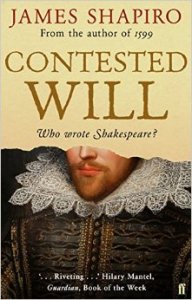
Contested Will or a look into why people deny Shakespeare

517jHQZPLjL._SY344_BO1,204,203,200_

By heaven, methinks it were an easy leap to pluck bright honor from the pale-faced moon, or dive into the bottom of the deep, where fathom-line could never touch the ground, and pluck up drowned honour by the locks. Henry IV Pt. I

If anyone is wiling to doubt on their authority, the history and existence of Christ, he must, in order to be consistent, be wiling to doubt on the same grounds, the history and existence of Shakespeare.

So begins a semi-satirical argument made in 1848 by Mosheim Schmucker in his book, Historical Doubts Respecting Shakespeare: Illustrating Infidel Objections Against the Bible (his publisher rejecting the shorter title of Oh Come on, seriously? because all great late 1800 book titles were required to be long and pretentious). Unfortunately for Schmucker, and to Shakespeare scholarship in general, his book was taken far too seriously.

The book was written as a response to another titled, The Life of Jesus, and the burgeoning “Higher Criticism” movement that inspired it. The phrase “Higher Criticism” described the study of the origins, date, composition, and transmission of the books of the Bible in order to separate fact from fiction. David Fredrick Strauss, one of the scholars who employed this method to the New Testament, came to the conclusion that there was no “supernatural, divine Christ, no miracles and no resurrection of the dead”. This did not sit well with the clergy (as one can easily imagine) and so Schumuker took it upon himself to write a response. The results were not what he had expected and sadly, we’ve been subjected to the 2011 movie Anonymous because of it.

To be Shakespeare or not to be Shakespeare. Allow me to take everything out of historical context while asking this question.

Schumuker, a historian and Lutheran pastor, decided to parody Strauss and his like by writing a book using the same arguments to determine if Shakespeare ever existed. Schumuker never doubted Shakespeare’s existence and assumed his readers would see the book for what it was intended to be; a satirical rebuttal to the argument that given the lack of historical data and contradictory stories surrounding Christ, we must conclude there was no Christ. He wanted his readers to see through Strauss’ argument using the “absence of evidence argument”. What ensued was not what he expected; it began the serious study of the authorship question that still rages today. Ironically, those seeking to question Shakespeare’s authorship used Schumuker’s book as their bible; using his arguments as talking points. Though the book is no longer regarded as the ultimate guide to the authorship questions, the arguments he presented are still in use today. Thanks to Schumuker and his obvious lack of satirical skills, the authorship question did not die a natural death. One could say he resurrected a question that was all but forgotten and gave it new life.

I found this story absolutely intriguing. It is one of several stories James Shapiro offer us in which we learn how and why the authorship question remains a topic of interest and debate. I learned that Mark Twain came to question Shakespeare as an author because in his later years he was convinced that all writing is consciously and subconsciously autobiographical. Twain was famous for his “truth” in fiction, but as he aged he began to believe that all writers expressed themselves in their works and that no one could write about things that they themselves had not experienced. I have to wonder if anyone pointed out to Twain that he was not a time traveler yet was able to write a lovely book on the subject.

A better-suited title for the book, Contested Will Who wrote Shakespeare? would’ve been Contested Will Why people deny Shakespeare, as this is what Shapiro offers us. It is the history of doubt and what led other wise intelligent scholars, writers, and armchair historians to question whether there ever was a playwright named William Shakespeare. I read it in one day as I could not put this book down. It is one of my favorite books regarding the study of Shakespeare.

I have to commend Shapiro for his even-handed style in which he presented these people and their stories. It could have been so easy for him to scoff and make fun of them, but instead he presents their cases in a respectful and very well researched manner. Yes, once in awhile he does ask a question or makes a remark but this on ensures that the book is lightheaded tone, rather than a dry academic read or catty argument against the Anti-Stratfordians.

Make no mistake, this book is about the authorship questions but it is much more; it is a fascinating look into historical scholarship and offers modern readers the chance to see the other side of literary debate. Who knew this all really started with one woman’s frustration with not being taken as a serious scholar and took off when a pastor overestimated his comedic writing skills? Thank you Mr. Shapiro for enlightening us as to why people deny Shakespeare.

Works Cited/ Referenced

American Psychology Association The psychologies of Mark Twain

William Shakespeare Henry IV part 1

James Shapiro Contested Will Who Wrote Shakespeare?

King’s Bazaar of Bad Dreams, more like a nap of fleeting thoughts

UK Cover Version
UK Cover Version

Have you ever awoken feeling a little shook up, or out of sorts because of a bad dream, one you can’t quite remember? I’m sure you have. You try to recall the details if only to sort out why it bothered you, why this particular dream…

If you started a book in 2015, but finished it in 2016, does it count as your first read of the new year? Let’s assume yes, only so that my yearly review is once again a Stephen King book. Last night I finished, The Bazaar of Bad Dreams, a collection of short stories, some previously published, one redone, and one expanded.

After finishing the book, I turned on HBO-Go, hoping to finish the night with a laugh, when I noticed that they finally brought back season one of True Detective. I’ve longed wanted to watch this ever since I caught a partial viewing of one of the last episodes, one that had me curiously riveted. I am only one episode in, so no spoilers please.

In one scene, Matthew McConaughey’s character says something deeply profound about the state of the town he has just moved it. He looks around the parking lot of a grown over boarded-up strip mall, outwardly dejected by what he sees. The mall’s condition is a metaphor on his feelings towards his new surroundings; “This town looks like someone’s memory of an American town, but the memory is fading”.

This quote struck me in many different ways and could be applied to many different ideas, most being political in nature, yet, as I started to write my review, I found that it also applied to King’s latest offering. Substitute the word “memory” for “dream” and you may get a feel for this book.

Have you ever awoken feeling a little shook up, or out of sorts because of a bad dream, one you can’t quite remember? I’m sure you have. You try to recall the details if only to sort out why it bothered you, why this particular dream…

King writes an introduction to each story, telling his constant readers how and why he came up with this particular story idea. I found these tidbits often more entertaining than the actual stories they produced. For me, these stories /dreams felt one-dimensional and wispy around the edges, as if they were fading or had never been fully formed to begin with.

King has always been a favorite of mine (long time readers know of my young adult obsession) because he magically creates well-rounded characters from which deep wells of emotions can be drawn from, even if their lives are only found in a few pages. This time the well turned out to be dry.

This first story, Mile 81, is the only exception, but having been previously published as a Kindle offering, long time readers are left with a collection of stories involving stories that don’t quite work, either they end poorly as with Ur or would have worked if they were longer as with Bad Little Kid and The Dune.

King’s constant readers may find pleasure in a few of these stories, Afterlife, the story of a recently deceased man who finds himself in an office and with a choice, is classic King, but most of others may disappoint. There is no running theme in this collection, other than to say they are a look into the dark side of life, but we expect that from King anyway.

These stories are King’s idea of bad dreams; perhaps they don’t work because he usually offers us up nightmares. These we hold on to, these don’t always fade with time. We constant readers cannot get Quitter’s Inc. or Stand by me out of our minds. The memory of these older stories are what keeps us up at night or have us thinking and talking about long after they end.

King says of this collection, “The best of them have teeth”. I wish that this was true, but the best of them do little more than nip at your brain. One or two may have you thinking, but not for long. The memory of the discomfort leaves you as swiftly as it arrived, leaving you wondering if you were truly uncomfortable in the first place. I’d gladly trade these bad dreams of Kings for his nightmares.

If you feel the way I do, I’d skip this book. If you need a King fix, go back and revisit Night Shift or Skeleton Crew, the best of these stories have fangs.

Amazing Waste

Repurposing Food and Reducing Waste

measurestillformeasure

Shakespeare, Classics, Theatre, Thoughts

Nerd Cactus

Quirky Intellect for the Discerning Nerd

Sillyverse

Stories of magic and mystery

Commonplace Fun Facts

Mind-Blowing Facts You Didn’t Know

Fictionophile

Fiction reviews, Bookblogger, Fiction book reviews, books, crime fiction, author interviews, mystery series, cover, love, bookish thoughts...

Patrick W. Marsh

monsters, monsters, everywhere

Shakespeare for Kids Books

Opening the door for kids to love Shakespeare and the classics

desperatelyseekingcymbeline

The 10-year Shakespeare New Year Resolution

Katzenworld

Welcome to the world of cats!

booksandopinions.com

The Book Reviews You Can Trust!

The Book Review Directory

For Readers and Writers

thelitcritguy

screams from the void

Author Adrienne Morris

Step Into the Past—Lose Yourself in the Story.

crafty theatre

ideas inspired by crafty characters

Critical Dispatches

Reports from my somewhat unusual life

The Nerd Nebula

The Nucleus of the Universe for all Nerd Hacks!