12 Higher brain insults

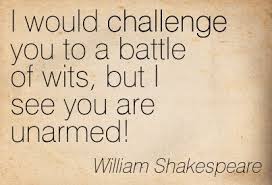
Shakespeare insult

We’ve all done it. At some point a hammer has missed its mark, a box has landed on a foot or a head has been knocked by an open cabinet or car door. And then, oh then, without thought an obscenity flies out! Maybe just one word or two, but the word(s) are spoken with venom and spite. Though if one is unaccustomed to using coarse language the object of one’s wrath may be merely dammed. Whatever the word(s) we feel better by cursing.

Experiments have shown that test subjects are able to keep their hands in freezing water longer when they repeat a swearword. Scientists believe that swearwords occupy a different part of our brain than does polite language. Most speech is a “higher brain” function while swearwords are stored in the “lower brain” the Limbic system, which is responsible for our emotions and autonomic nervous system. Swearwords may activate endorphins, which in turn interact with the opiate receptors in the brain to reduce our perception of pain. This would be all well and good if we only used swearwords as automatic pain reducers but we do not. Over the centuries we have directed curses, oaths and obscenities to our fellow man, and we are not the better for it. It has become the lazy vocabulary of our culture. When we cannot come up with something clever to say, we resort to ignorant language.

The reason I bring this all up is because I’m reading Melissa Mohr’s book, Holy Sh*t. A brief history of swearing. In it she reminds us that linguistically, a swearword is one that” kidnaps our attention and forces us to consider its unpleasant connotations”. The connotation gives the word its emotional punch. The connotation of f*cking, could mean really, really bad or working hard at something, depending on its use. The word itself is only taboo because of its connotation.

We use swearwords for a variety of reasons but no matter the reason or connotation we want to get across, we are engaging our lower brain when we do so. The idea that we sometimes allow our Limbic system to take over when telling someone off leads to questions. Does the act of telling someone off itself activate our lower brain or is it the language that we use? Do we do a double stoop by not only resorting to course language but also by wanting to? These are the kinds of questions that keep me in the shower longer than I should or reading further into Mohr’s book. I started making some notes because I wanted to know if there was a better way to tell someone off, or describe a horrible person while still using our higher brain? Of course we could just stop saying bad things to and about people, but sometimes there is no better option. Sometimes people need to be told off and described in harsh honesty.

Luckily I came up with an answer, one that allows us to use our higher brain and stops us from using lazy and ignorant language. Of course the answer is Shakespeare! Our Will was a master of insults and barbs. Many of his plays would not work as well without them. Of course he threw in an Elizabethan swearword or two to get his point across, but overall he showed us that a witty turn of a phrase was just as effective. So the next time you are forced to mentally dual with someone, yell at a teammate for a bad play or have the last word, I give you

 12 Shakespeare insults.

Each one was picked for how quickly it can be memorized and how seamlessly it fits into today’s language.  *Modern spelling is an option.

 As you like it

Let’s meet as little as we can

I do desire we may be better strangers

In civility thou seem’st so empty

All’s well that ends well

You show yourself highly fed and lowly taught

Henry VI part 2

That is too much presumption on thy part

The Tempest

Hell is empty and the devils are all here

You freckled whelp hag-born

Look, he is winding up the watch of his wit: by and by it will strike

You are living drollery

King Leer

I have seen drunkards do more than this in sport

Love’s Labour Lost

Come, come, you talk greasily: your lips grow foul

O! thou monster Ignorance, how deform’d dost thou look

10 things you don’t know about the British Museum

British Museum

Today marks the 225th anniversary of the British Museum. It opened on January 15th, 1759. If I had a bucket list a visit to the museum would be number 1. But since a trip to London may be a year or two away I decided to take a virtual tour today to give you:

 10 things you don’t know about the British Museum

How to get rid of the thousands of items your heirs don’t want

The origins of the British Museum lie in the will of the physician, naturalist and collector, Sir Hans Sloane (1660–1753). Over his lifetime, Sloane collected more than 71,000 objects which he wanted to be preserved intact after his death. So he bequeathed the whole collection to King George II for the nation in return for a payment of £20,000 to his heirs. The gift was accepted and on 7 June 1753, an Act of Parliament established the British Museum.

 It’s just an old library

The founding collections largely consisted of books, manuscripts and natural specimens with some antiquities (including coins and medals, prints and drawings) and ethnographic material. In 1757 King George II donated the ‘Old Royal Library’ of the sovereigns of England and with it the privilege of copyright receipt.

If you open it, will they come?

The museum first opened its doors on the 15th January 1759 in Montague House, a seventeenth-century mansion on the site of the current Museum. The museum quickly grew in popularity with the masses and with the wealthy who found a new way to one-up each other; bequeaths and “acquisitions” forced the library to move several times to larger locations.

Roughly 80,000 objects are on public display at the British Museum at any one time. This is 1% of the collection. Many of its objects are light sensitive and cannot be displayed.

Can’t make it to the museum?  Don’t worry 2 million objects and background information are available to the public through the online catalogue. The app is pretty impressive as well.

Oldest stone tool in BM

The Oldest piece in the museum

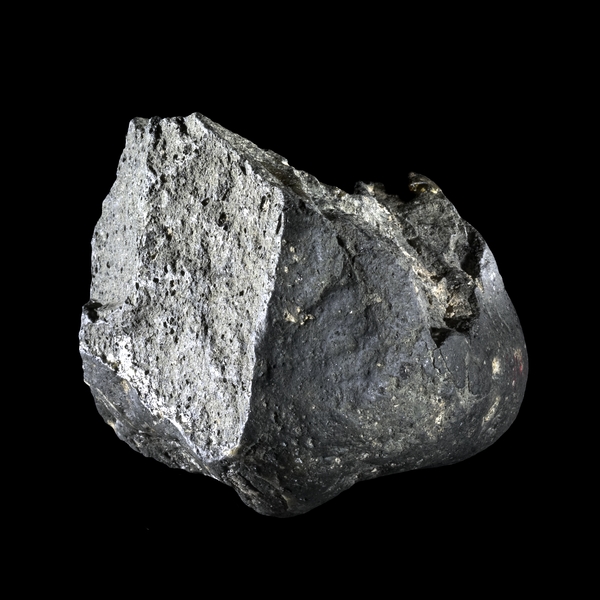
The Olduvia stone tool From Olduvai Gorge, Tanzania, is 1.8-2 million years old. To date, this is the oldest piece housed in the museum.

So what else would we see?

Among the vast collection are: the Rosetta Stone; statues that once adorned the Parthenon in Athens, Greece; a four-ton stone likeness of the pharaoh Amenhotep III; and several mummified cats from ancient Egypt.

Sutton Ho helmet

Many objects from the Sutton Hoo burial ship are on display at the museum. This would be reason enough to visit.

Caveman shopper

Best museum hoax ever!

 In 2005, a then little-known hoaxer named Banksy tricked museum staff by putting a ‘cave painting’ of a primitive man pushing a supermarket trolley on display. It was up for only a few days, though you may find it now in the Kentucky Creation museum.

Oddest Piece

A life-size carving of a human skull made from a single block of rock crystal (a clear, colorless variety of quartz). It was acquired by the Museum in 1897 purporting to be an ancient Mexican object. However scientific research conducted by the Museum has established that the skull was most likely produced in the nineteenth century in Europe. As such the object is not an authentic pre-Columbian artifact.

Pompeii victim

And you thought a mummy might be a little too much

Last March through September, visitors lined up to get a firsthand look at life in ancient Rome. This up close and personal view was only possible because of the terrible tragedy that devastated Pompeii and Herculaneum in 79 AD. The exhibition included casts from in and around Pompeii and of some of the victims of the eruption. A family of two adults and their two children are huddled together, just as in their last moments under the stairs of their villa. The most famous of the casts on display is of a dog, fixed forever at the moment of its death as the volcano submerged the cities. I’m not sure I would want to get that up close. I trip to the museum should not result in tears and sorrow. With that in mind, I will leave you with John Oliver’s take on the British Museum. Hopefully you find him as funny as I do. Enjoy

Amazing Waste

Repurposing Food and Reducing Waste

measurestillformeasure

Shakespeare, Classics, Theatre, Thoughts

Nerd Cactus

Quirky Intellect for the Discerning Nerd

Sillyverse

Stories of magic and mystery

Commonplace Fun Facts

Mind-Blowing Facts You Didn’t Know

Fictionophile

Fiction reviews, Bookblogger, Fiction book reviews, books, crime fiction, author interviews, mystery series, cover, love, bookish thoughts...

Patrick W. Marsh

monsters, monsters, everywhere

Shakespeare for Kids Books

Opening the door for kids to love Shakespeare and the classics

desperatelyseekingcymbeline

The 10-year Shakespeare New Year Resolution

Katzenworld

Welcome to the world of cats!

booksandopinions.com

The Book Reviews You Can Trust!

The Book Review Directory

For Readers and Writers

thelitcritguy

screams from the void

Author Adrienne Morris

Step Into the Past—Lose Yourself in the Story.

crafty theatre

ideas inspired by crafty characters

Critical Dispatches

Reports from my somewhat unusual life

The Nerd Nebula

The Nucleus of the Universe for all Nerd Hacks!