In the age of digital interaction, what counts as friendship?

Friendship-Sayings

While talking to my assistant yesterday I mentioned my love of podcasts. Without thinking I said, “I have two friends who host a thought provoking podcast on Sunday afternoons”. As soon as the words fell out of my mouth, I started to question my use of the term “friend”. I started to wonder, “are they my friends or are they acquaintances”? Why did I choose that word, and why was it so easy to think of them as friends even though we’ve never met face to face? In the age of superficial connections via social media, who is it that we can truly call our friend and who, an acquaintance?

Merriam Webster defines an acquaintance as:  Someone who is known but who is not a close friend The state of knowing someone in a personal or social way : the state of knowing someone as an acquaintance

This definition doesn’t seem to be at all helpful. If you know someone in a personal way, wouldn’t that person be your friend, or someone, because you personally know what she or he is like, is someone to avoid? We need a better definition.

Thanks to Facebook, we have come to loosely throw the term “friend” around when speaking about someone we’ve had even the slightest contact with. Before FB installed its Page feature, celebrities and authors looking to engage with their fans had to become “Friends” with them. Back in 2012 I became “friends” with Dr. Neil deGrasse Tyson and even had a one on one conversation with him, but in no way did that count as friendship. So what does?

Who is the friend and who is the acquaintance?

Take these two people as examples: one is someone with whom I am in almost daily contact with, even if it’s a quick note on her FB wall. We’ve been in contact for almost 9 years. In those 9 years we’ve managed an online book club together, wrote long personal e-mails (I owe her one) and have exchanged Christmas gifts. I can still recall the thrill of picking out books for her daughter’s 6th birthday. But for all of that, we’ve never met face to face. The other is someone that I went to school with. Someone I hung out with middle school (somewhere in my collection of pictures is one of us dancing at my 13th birthday party). Of course we lost contact after high school and it wasn’t until the invention of FB did we reconnect. I have no idea what his wife’s name is, or how long they’ve been married. Once in a while we post a comment on each other’s wall, and give the obligatory birthday greeting. Yet despite the fact that he and I went to school together and at one time had a personal relationship, I’d be hard pressed to say we are truly friends. He has become an acquaintance, while my online friend and I share a very close personal relationship.

The above example seems obvious, we are learning in large part thanks to the Internet, that real friendships can develop even if distance keeps us apart. But that doesn’t answer my original question, given that we can now connect with authors, podcasters, bloggers etc. Who is it that we can truly call our friend and who an acquaintance?  Have we’ve been conditioned to use this term as a catch all for our daily social interactions? What is the line between friendship and a casual acquaintance? Surly not everyone we interact with are true friends.

That last question was key to my understanding of why I called the two above mentioned podcasters my friends. I’ve subconsciously formed an idea of whom I call friend. We all have I’m sure. I even suspect we all have list of what makes up a friendship or at least a vague idea of such a list.

The more I pondered the term “friend” and how I use it, the more important this list seemed to be. So I sat down and wrote one out in order to answer my question and understand why I called two guys I’ve never met, friends. This is how I determine whom I feel comfortable calling friend. I was a little hesitant to share it, as I am sure there will be those reading it that don’t agree or may feel uncomfortable with my idea of friendship. Don’t worry, most of you will never be asked to help me move or get that frantic 2am call.

I once had a boyfriend tell me my internet relationships were not real. He's gone, but my online friends remain.
I once had a boyfriend tell me my internet relationships were not real. He’s gone, but my online friends remain.

You might be Sari’s friend, even though we’ve never met if:

We’ve stayed in contact for a long period of time, even if that contact has moved from one form of social media to another. We’ve shared our ups and downs and know as much, if not more, than the people in our daily lives.

You share personal pictures and stories on your FB wall and or blog and we talk about them, and we do this on a regular basis. I know about your family and your achievements and you know about mine. We cheer each other on and give sympathy when needed.

We feel comfortable posting possible unpopular opinions, knowing the other will not be offended because we both value honesty and differing points of view. And we do this quite often.

I am one of the few people that you will get back to right away. Whenever I e-mail or send a quick Tweet, you make sure to respond right away. We may not communicate often but when we do it is never shallow or impersonal.

Our conversations have moved beyond what brought us together in the first place. If we stay on one topic, then we are acquaintances who share similar tastes and worldviews.

In short, those I call friends know and value my opinions, take me for who I am and are comfortable being themselves around me. We share pieces of our lives, sometimes small, and sometimes more than we share with others. We may not be in constant contact, but when we do communicate it is always a good feeling. And that, I believe, is the cornerstone of all friendships, no matter the distance between us.

I count myself in nothing else so happy
As in a soul remembering my good friends.
William Shakespeare Richard II

If you have an idea or list of things that you use to determine friendship let us know. All comments are welcome.
Barbie is not the problem

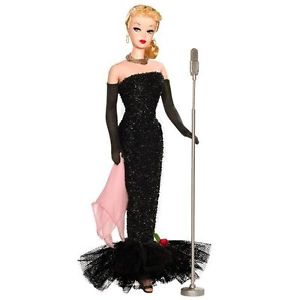
With enough airbrushing any celebrity  can now look perfect like Barbie
With enough airbrushing any celebrity can now look perfect like Barbie

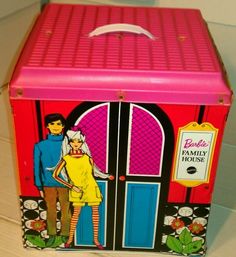
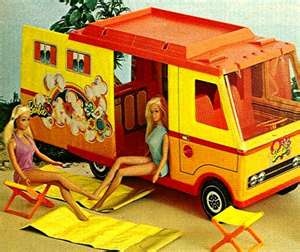
I’m going to go out on a limb here and say that if you were a young girl in the 60’s and 70’s you owned at least one Barbie, possibly more. My own serious obsession with Barbie started in 1968, and didn’t end until 1975. In those 7 years I owned a large collection of Barbies including vintage dolls handed down from older cousins. I had a Barbie Family House, Barbie camper, Barbie jet, and one of the first Barbie sport cars that looked like a cross between a Mustang and Bentley.

Barbie was the toy of the 70’s; her image was everywhere. You couldn’t turn a corner without seeing her blond face. From books to Halloween costumes, to bedding and shoes, Barbie dominated American childhood.

I never pretended to look perfect like Barbie. I pretended to go camping with her.
Family House my ass. It consisted of three "rooms" and just enough space for two dolls.
Family House my ass. It consisted of three “rooms” and just enough space for two dolls.

Back then parents didn’t complain about Barbie’s small waist and big chest. The big joke was that Barbie was short on funds, but large on goods. “For a woman that doesn’t have a job, she sure has a lot of stuff”. But over the years this has changed. Mattel, the maker of Barbie, has taken a big hit from groups who feel Barbie gives little girls unrealistic expectations about themselves and wounds pre-adolescent self-esteem. This criticism is why Mattel unveiled a new line of Barbies, a line that includes a long needed variety of skin tone, but also an unnecessary choice of body proportions, which may do more harm than good. You see, Barbie isn’t the problem.

Didn't we already try this with Skipper and Trixie?
Didn’t we already try this with Skipper and Trixie?

I played with Barbie between the ages of 5 and 11. One of the things I did on my 12th birthday was to pack up all of my Barbies and accessories and lend them to a younger neighbor (a move I still regret, as I never did get them back). As a 12 year old with a new record player and skates, I no longer had any need of my childhood fantasies. At this age I was wise enough to know Barbie was a toy and that no matter how much I played with her, I would never be like Barbie. Truth be told, it was never Barbie I wanted to be or look like in the first place.

B3malibu-barbie

In the 1960’s & 1970’s the ideal American beauty was the fresh faced tall, blond, blue eyed, tanned girl. The Beach Boys sang about her in California Girls and shampoo commercials always showed her waving her long blond locks in slow motion. Compound that with the fact that my older cousins, the ones who gave me my first set of Barbies, looked like the perfect Breck Shampoo models, and you can see why I may have had self-esteem issues. I was short, dark haired, and brown eyed. I looked nothing like my cousins or the girls on TV and in fashion magazines. But the truth of this did not hit me until after I stopped playing with Barbie.

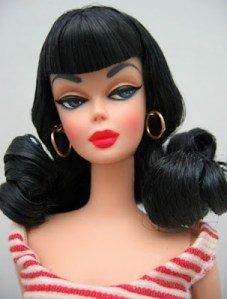
I only remember once expressing a desire to look like Barbie. I said this to one of my cousins when I was 6 and after we had seen Sleeping Beauty in the theater (in the 60’s theaters were playing Disney movies in the summer months so kids could see them for the first time on the big screen). It wasn’t Barbie that I wanted to look like, it was princess Aurora that struck my young mind as the perfect female image, and surely Barbie was modeled after her. My cousin laughed and handed me Barbie’s dark haired friend Midge and said this is who I would grow up to look like. I was crushed. I don’t think my cousin was being overtly mean, and I am sure neither one of us knew how deep that statement would cut as I grew into my teen years. Being labeled as not looking like what society deems beautiful is way more damaging than playing with a doll that doesn’t look like you.

66ff8054141113d15c28e72bc3b8041b
Perhaps if we had dark hard role models back then I would have been thrilled with the label. I now see the beauty in this doll.


And, after a page of rambling, this is my point about the new and “improved” Barbie.

I don't know any 8 year old who looks like either of these two dolls.
I don’t know any 8 year old who looks like either of these two dolls.

While I applaud Mattel’s decision to produce dolls with varying hair and skin colors, I am not so sure the curvy doll will do little girls any good. First of all, the target audience for Barbie are preadolescent girls and I’ve yet to see a curvy 8 year old; chubby, yes, but curvy no. I understand that the message Mattel is offering is one that says women are beautiful no matter what your body size, but until society agrees, it won’t be heard. I’m a curvy woman and feel that my body is just fine, but this goes against what society tells us. Not that society should dictate how we feel about ourselves, but the mixed messages that come with the new curvy Barbie may prove to be damaging. Giving a child a doll that you think will most represent her in adulthood is providing a label for the future girl. One that she may not agree is positive.

When a parent offers their child a more true to life curvy Barbie, they are essentially telling that child that she will grow up to look like this, without taking into account the child’s athletic potential or genetic makeup that may be slightly different than her mother’s. We don’t give boys action figures that most represent what we think they will look or be like because we know these are just toys designed for fun. So why is Barbie held to a different standard? Barbie is not the problem.

The problem of body image and the effects it has on young girls is not a result of years of playing with an unrealistic toy. There are many young girls who have never played with a Barbie yet suffer from poor body image. I say to the same groups who pushed Mattel’s change, you should do the same with the media, for this is where the true problem lies. In fact it’s ironic that Barbie started out as a fashion model, and as we all know, fashion models do not represent what the majority of woman look like, so why be pissed off that Barbie doesn’t either? If you are so worried about your daughter’s self esteem issues, why give her a fashion doll in the first place? I have an idea, why not give her a science kit instead and encourage her to change the world?

As a young girl I never seriously considered Barbie to be my personal role model nor did I limit my life choices to what she represented. I used my imagination to explore my future possibilities. But if my cousin had taken away all of my blond Barbies and only allowed me to play with Midge, the idea that I didn’t fit into what society says is beautiful would have only cut deeper. I am afraid that by handing a little girl a true to life curvy doll, her image of herself will not magically improve. She may view her potential self critically and enjoy her teen years less as she waits for the dreaded curves to show themselves. Why can’t we just let little girls have the same fun that we let little boys? Where is the outcry over G.I Joe and his perfect body?

This push for a new Barbie size sounds like misplaced anger. Why don’t we start with the media and work our way down to toys? Until magazines stop airbrushing celebrities, until we stop spending billions on plastic surgery, and worshiping homemade porn stars turned TV stars, the outcry over Barbie rings hollow. If you teach your daughter to love and honor herself no doll will change that.


Amazing Waste

Repurposing Food and Reducing Waste

measurestillformeasure

Shakespeare, Classics, Theatre, Thoughts

Nerd Cactus

Quirky Intellect for the Discerning Nerd

Sillyverse

Stories of magic and mystery

Commonplace Fun Facts

Mind-Blowing Facts You Didn’t Know

Fictionophile

Fiction reviews, Bookblogger, Fiction book reviews, books, crime fiction, author interviews, mystery series, cover, love, bookish thoughts...

Patrick W. Marsh

monsters, monsters, everywhere

Shakespeare for Kids Books

Opening the door for kids to love Shakespeare and the classics

desperatelyseekingcymbeline

The 10-year Shakespeare New Year Resolution

Katzenworld

Welcome to the world of cats!

booksandopinions.com

The Book Reviews You Can Trust!

The Book Review Directory

For Readers and Writers

thelitcritguy

screams from the void

Author Adrienne Morris

Step Into the Past—Lose Yourself in the Story.

crafty theatre

ideas inspired by crafty characters

Critical Dispatches

Reports from my somewhat unusual life

The Nerd Nebula

The Nucleus of the Universe for all Nerd Hacks!