Shakespeare and The Walking Dead- Words, Words, Words!

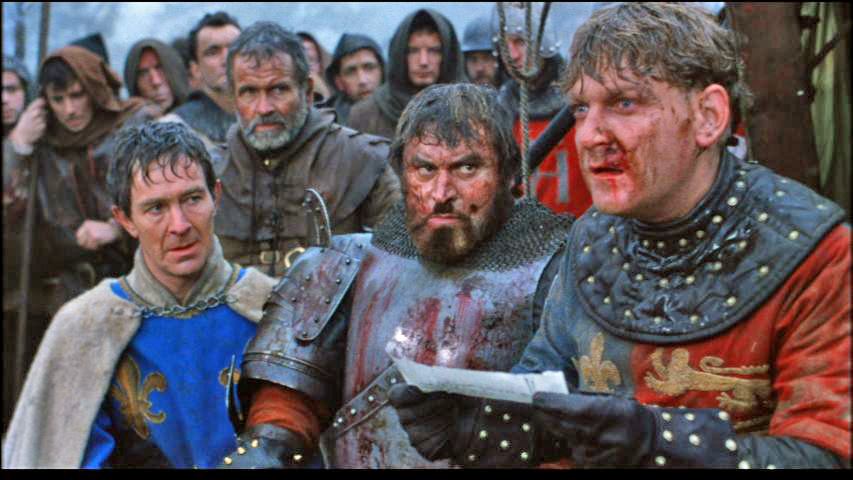
Henry-V-Branagh

I pulled out an older post, as it may be a timely subject.

Did you know Friday September 20th, PBS is going to air the British mini-series The Hollow Crown? The series is an ambitious production of all of Shakespeare’s  most fascinating  history plays; Richard II, Henry IV, Part 1, Henry IV, Part 2 and Henry V. Shakespeare fans should not miss this!

This last week we watched as President Obama used threatening words towards Syria much as Henry threatened the mayor of a small French village, (see quote below). Henry’s threats compels the mayor into action, or to be exact, nonaction. The mayor allows Henry to take the village. Obama’s words may end up having similar effects on Syria. No, the civil war will not end, but hopefully the gassing will.

As you watch the Hollow Crown, listen to the words words words! Some of Shakespeare’s most powerful speeches are found in these four plays.

I don’t know about you, but I’m a huge fan of the AMC show The Walking Dead. I like it for a variety of reasons, the biggest being my fascination with how people would deal with life in a dystopian world. How they adapt and the choices they make are why I continually find myself drawn to this type of literature and why I watch the show. It doesn’t hurt that Norman Reedus is smoking hot!

Last night’s episode was a great example of storytelling through the use of conversation. The backstory of the Dixon brothers could have been shown via flashbacks, as so often depicted in TV, yet the writers chose to unfold their personal drama with carefully worded imagery. It was painful to watch, yet beautifully played out. I don’t want to spoil the show for anyone who has not watched it yet, so I will only add that many of the characters resolved conflicts and divulged secrets all through the magic of conversation; that is until the last few minutes of the show, then all hell broke lose and the usual carnage ensued.  But, because of the dialog, it is my favorite episode to date.

This morning I read a blog post by a TV critic who blasted the show because of “all the talking the Dixon brothers did”. The critic whined that there was too much talking and not enough action. That the brothers showed their true colors through words and action, was lost on her. She had no appreciation for the power of speech. This got me thinking; would she have posted a negative review on Shakespeare’s Henry V play?

For those of you who may not be familiar with this particular play, it is one of Shakespeare’s history plays. Henry V is crowned King of England and his first act is to declare war on France. The play’s focus is on the war between the two countries. Historians cannot agree if it a piece of national propaganda or an anti-war play.  I’m studying the play this week and one of the things we are talking about is the fact that Shakespeare chose not to enact any battle scenes as he had done in previous plays. He uses only words to show his audience the effect that war has on those who desire to conduct them, those who are duty bound to fight them and the people caught in the middle. In his most brutal speech, Henry tells the mayor of a town who won’t let him enter the gates:

Defy us to our worst: for, as I am a soldier,
A name that in my thoughts becomes me best,
If I begin the battery once again,
I will not leave the half-achieved Harfleur
Till in her ashes she lie buried.
The gates of mercy shall be all shut up,
And the flesh’d soldier, rough and hard of heart,
In liberty of bloody hand shall range
With conscience wide as hell, mowing like grass
Your fresh-fair virgins and your flowering infants.

With dialog like this, you don’t need to witness what Henry’s army will do in order to win the town of Harfleur and those like it. Shakespeare allows us to imagine what invading armies are capable of, once let loose. The entire play is like this, there is no need of battle scenes or of the dead and wounded; the words the characters use tell us a compelling war story. It’s ironic that movies based on Henry V do show the battles, as if modern audience could not comprehend a war movie with out them.

I think today’s movie and TV audiences require too much action, they don’t know how to allow words to be the action. I can only imagine what the whiny Walking Dead critic would say about Shakespeare writing a war play without depicting actual war.
Metamorphoses: Intro & The Flood

metamorphoses-ovid-cd-cover-art

Publius Ovidius Naso (or Ovid as we know him) was born on March 20th 43 BCE, in the small town of Sumo, not far from Rome.  We are told he was a brilliant student who excelled in rhetoric. But rather than becoming a Roman statesman’s as his father wished, Ovid devoted his life to poetry. By the time he was thirty, Ovid had made a name for himself with the publication of his Amores poems. We remember him as the author of Metamorphoses, an epic poem spanning the beginning of time down to his own day. Ovid retooled Roman and Greek myths, giving his readers a comprehensive story of the many interactions between Gods and man, linked together by the theme of transformation or “metamorphoses”. His epic tale was so successful that almost every retelling of Roman and Greek myths since the fall of Rome have been Ovidan myth.

Here is what Penguin Classics has to say about Ovid’s Metamorphoses:

  1. Ovid’s myths cover an extraordinary range of experiences and he displays a penetrating psychological knowledge of the variety of human and motivations and delusions.
  2. The main connecting thread is an interest in identity: what is it about a person that makes them that person, and what is it about humans that make them human?
  3. Epic for Ovid is not just a narrative genre, but a way of viewing the world.
  4. Ovid is not inventing an issue but responding to something already there in his models.

If you are a student of Shakespeare these four quotes may sound familiar. Scholars have said the same things about world’s most famous playwright. The noted critic Harold Bloom went so far as to say “Shakespeare invented what it means to be human”.
It is no coincidence that both writers have been credited for covering such extraordinary ranges of experiences and penetrating the human psyche. Ovid’s grand epic was Shakespeare’s favorite piece of writing. Having only gone through the first three Books of the fifteen that make up Metamorphoses, it is clear to me that Shakespeare was very much influenced by the poem. If we take a step back from the plays we can see there is a running theme of transformation found in almost all of them.
The reason I picked up Metamorphoses was due to its influence on Shakespeare. I wanted to read first hand the stories that enthralled the young boy Will Shakespeare, and if I could find the adult William Shakespeare in them.
Immediately I was pulled in Ovid’s world. Having taken and enjoyed a few university courses on religions I was mesmerized by Ovid’s take on the chaos myth. By the third tale I let my quest for Shakespeare take a backseat while Ovid steered my mind back to a time when Gods fought and loved mankind. When the extraordinary was the norm.
rome-is-flooded
This intro to Metamorphoses is now longer than I anticipated it would be. Instead of talking about two stories, The Flood (Book 1) and Phaethon (Book2), I will just make a brief comment about The Flood and save Phaethon for my next post.

For those not reading along, Jove is furious by a slight made by the human King Lycaön. So in a fit of rage, he declares he will wipe out the entire human race with a flood. Other gods worried about the lack of worshippers “Who will bring to our altars the offerings of incense? Is earth to be left to the mercies of raving wild beasts?” Oh can’t you just feel their compassion towards humanity? Jove declares he will take care of them with promises of a “race of miraculous birth, unlike the people before it”. (In case you are wondering, the creation story included spontaneous generation, something the ancient Greek, Anaximander taught. How else do you get mice in a closed barn of hay?)

What struck me as I read about the flooding of the world was Ovid’s exclusion of scenes of the wicked drowning (Jove says that there are many wicked men) but of the temples and alters slowing sinking and toppling. “…houses and shrines with their scared possessions were swept to oblivion”.

I have to ask, “What is Ovid saying?” Is he making the point that the gods are merciless, that so many had to die because a few offended the gods? Or is he pointing out that faithful worship is futile because the gods do what they want and disregard humanity? Finally, could this be a political comment, Ovid’s attempt to show the destructive nature of conquest?

Ovid grew up during the reign of Augustus, a relative peaceful time for Rome. Yet Augustus greatly expanded the empire moving into the east and west, wiping out indigenous cultures and replacing flooding them with Rome’s beliefs and values. Perhaps Ovid had something to say about this, or perhaps not. For those of you reading along or having already read the poem, tell me what you got from The Flood (there is more to discuss about this story) or if you like any other story from Book 1.

Later this week Phaethon

Amazing Waste

Repurposing Food and Reducing Waste

measurestillformeasure

Shakespeare, Classics, Theatre, Thoughts

Nerd Cactus

Quirky Intellect for the Discerning Nerd

Sillyverse

Stories of magic and mystery

Commonplace Fun Facts

Mind-Blowing Facts You Didn’t Know

Fictionophile

Fiction reviews, Bookblogger, Fiction book reviews, books, crime fiction, author interviews, mystery series, cover, love, bookish thoughts...

Patrick W. Marsh

monsters, monsters, everywhere

Shakespeare for Kids Books

Opening the door for kids to love Shakespeare and the classics

desperatelyseekingcymbeline

The 10-year Shakespeare New Year Resolution

Katzenworld

Welcome to the world of cats!

booksandopinions.com

The Book Reviews You Can Trust!

The Book Review Directory

For Readers and Writers

thelitcritguy

screams from the void

Author Adrienne Morris

Step Into the Past—Lose Yourself in the Story.

crafty theatre

ideas inspired by crafty characters

Critical Dispatches

Reports from my somewhat unusual life

The Nerd Nebula

The Nucleus of the Universe for all Nerd Hacks!