7 things you may not know about Smokey Bear

Smokey3

If you’ve grownup in America this picture is very familiar to you. Smokey Bear is one of the most recognizable icons of American culture along side Santa Clause and Mickey Mouse. But how much do you really know about this beloved bear? Today marks Smokey’s 70th birthday, so I give you..

7 things you may not know about Smokey Bear

They call me Smokey Bear!

When the general public refers to him he is usually called “Smokey the Bear”, but this would be wrong. His actual name is Smokey Bear. The confusion began in 1952, when Steve Nelson and Jack Rollins wrote a song in his honor and added a “the” between “Smokey” and “Bear”.

His real origins

Many believe Smokey’s story started in 1950, when a small badly burned bear cub was found in the aftermath of a wildfire in the Lincoln National Forest, New Mexico. His story made headlines and captivated the country. The young bear was given the name “Smokey” and was used to bolster the image and propaganda of Wildfire prevention. Sadly, instead of nursing him back to health and then releasing him back into the wild, Smokey spend his remaining days as an exhibit in the Washington D.C. National Zoo. After his death in 1975, he was buried in the newly named Smokey Bear Historical state park, near the place of his “rescue”. This is the story the U.S. Forest Service sells in everything from Smokey comic books to school visits by Smokey (minus the zoo encampment part) but this isn’t the truth.
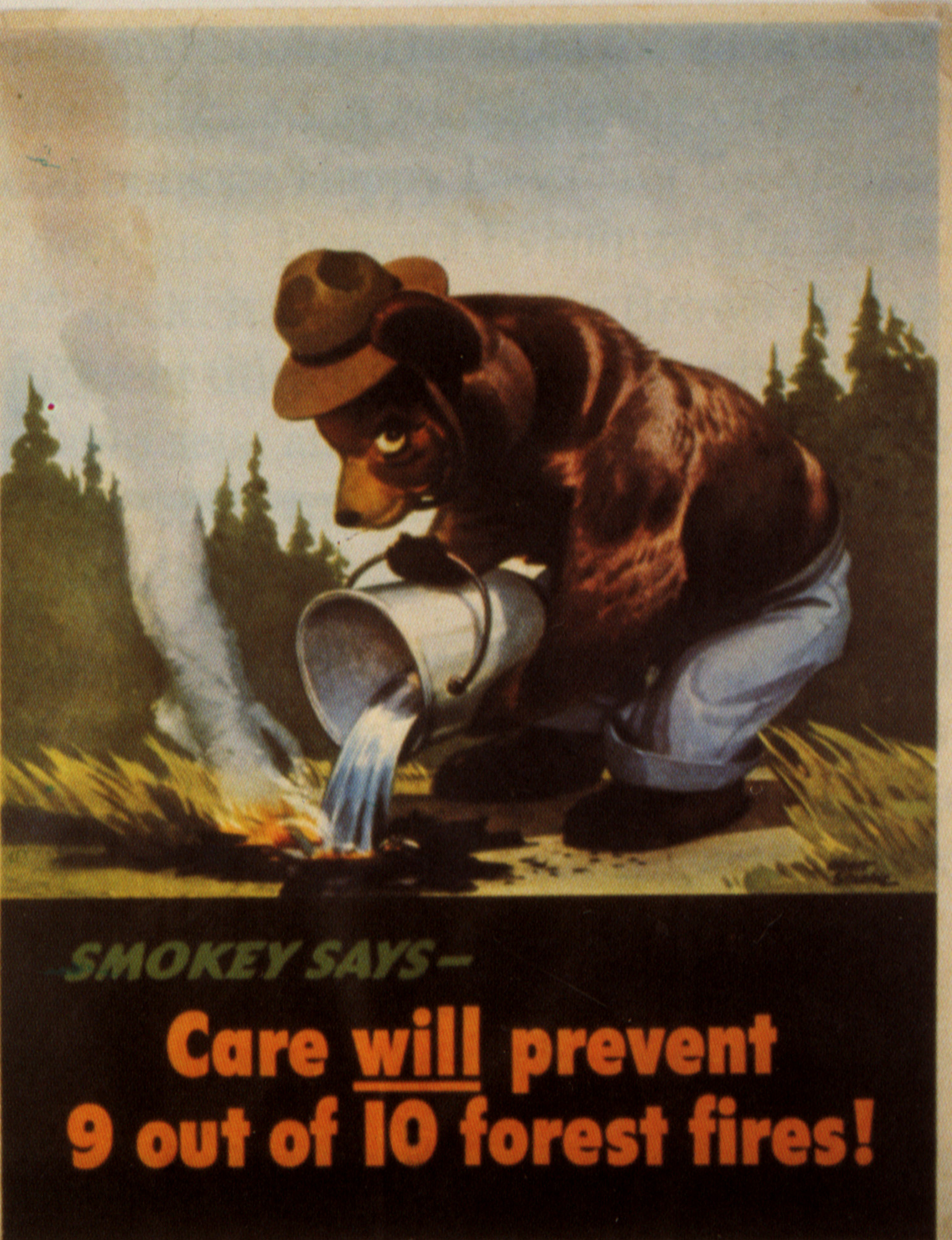
 

One of the first ad posters

The image of Smokey Bear was first used in 1944, as part of the War Department’s effort to get Americans involved in an anti-terrorism campaign. For reasons never fully explained, the government was afraid our enemies might fly over and start forest fires. The government wanted its citizens to be on the lookout for such fires. As part of their “We must treat them like children” campaign, the government came up with this poster in order to capture the American public’s attention.

Smokey’s love life?

In 1962, the National Zoo brought in a female bear named Goldie in the hopes that the aging bear would produce an heir. No such luck. Smokey must of ended up in Goldie’s “friend zone”, because no offspring came of their pairing. An “adopted” son was given to the couple so Smokey could retire. The subject of grandchildren never came up.

He receives how much fan mail?

The living image of Smokey Bear became so popular with American school children he was given his own Washington DC zip code of 20252 in 1964.
stelprdb5063238

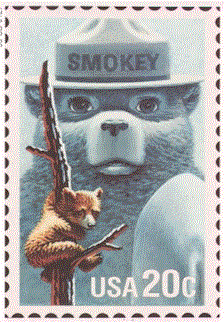
Use this stamp when mailing your letters.

In 1984, the U.S. Postal Service created a postage stamp with the image of a small bear clinging to a tree in celebration of Smokey’s 40th birthday. This is the only time the postal service has honored an individual animal.

Changing catch phrases

The campaign’s original catch phrase was “Smokey Says – Care Will Prevent 9 out of 10 Forest Fires.” In 1947 it was changed to “Remember… Only YOU Can Prevent Forest Fires.” Most recently, in 2001, it was again modified to “Only You Can Prevent Wildfires” in response to a massive outbreak of wildfires in natural areas other than forests.

Smokeybear

A talking bear?

When Smokey was first introduced in recorded media (TV and radio) he did not say anything other than his signature catch phrase. To the disappointment to thousands of children nation wide, when making public appearances he does not talk. Sometimes as he walks away he may utter the line “Remember children, only you can prevent forest fires”. The Forest Service is very clear on this rule. Smokey is not allowed to talk. His “handler” does the talking for him. When working for the Nevada Division of Forestry I found out about the rules of the Forest Service pertaining to Smokey’s use. Only government entities like state forest departments are authorized to use his image.

Smokey has jumped on the social media bandwagon. He has a Twitter handle and his own Facebook page. Here you can find Smokey “talking”, yet on audio media he remains quiet. He gives out silent hugs on Youtube.

smokey-bear-hug


And now you know! Happy Birthday Smokey
When is a Shakespeare play not Shakespeare?

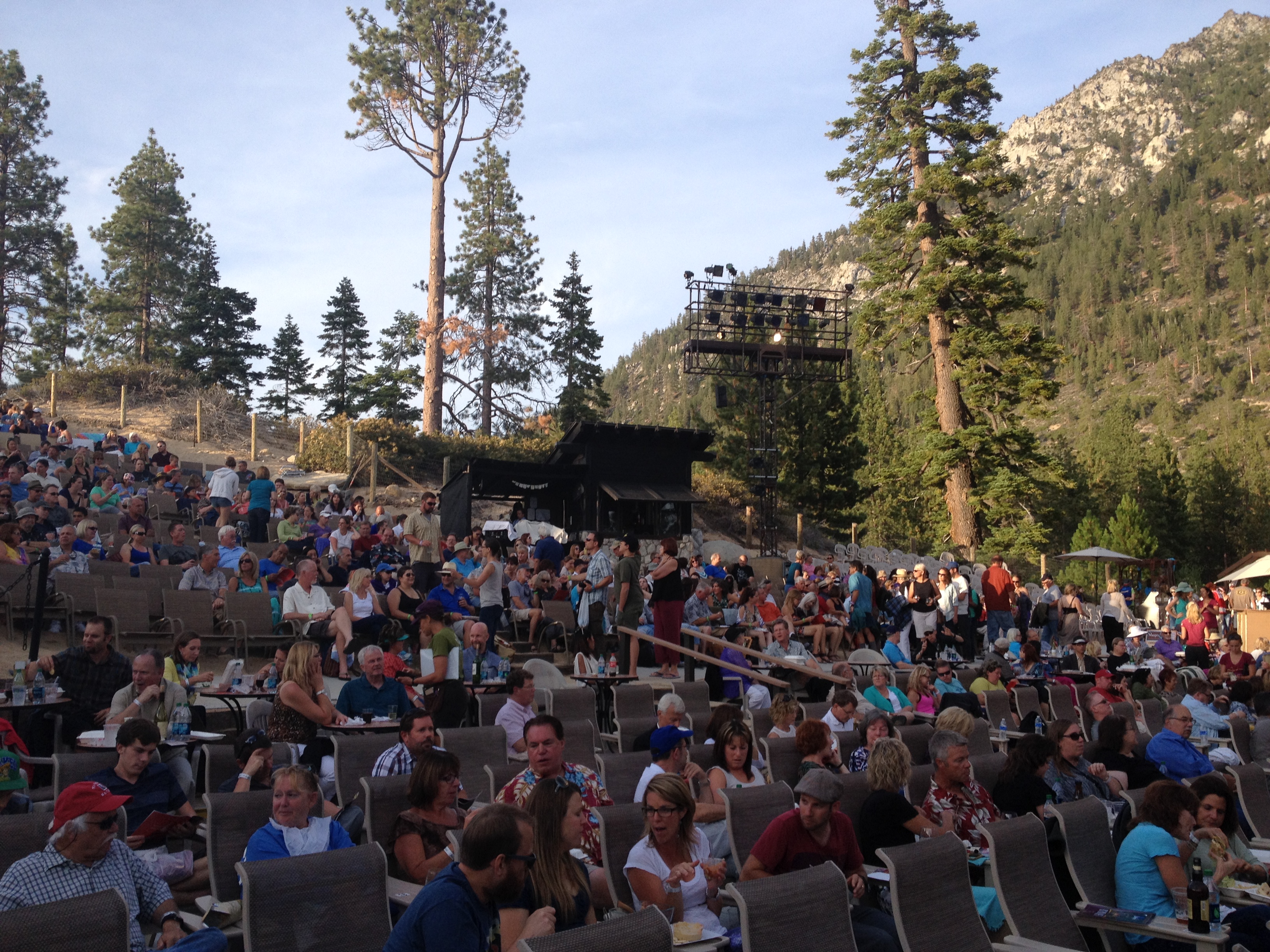
Getting ready for the play
This backdrop is supposed to tell us where we are. Can you figure it out?


There was a large crowd for the August 2 production of Lake Tahoe’s Shakespeare festival. As you can see a nice  crowed had gathered for a night of cultural entertainment. How can you go wrong with one of Shakespeare’s best well written plays? Some of Shakespeare’s best lines are found in this play. From the well known, “All the world’s a stage” speech to Touchtone’s witty comebacks, what the play lacks in plot more than makes up for it with very witty writing. One would have to try very hard to screw this up. Yet, as much as I enjoyed the performance of the actors, a question came to mind as I watched. When is a Shakespeare play not Shakespeare?

I’m well aware that most modern productions of Shakespeare discard Elizabethan settings and dress in order to connect with their 21 century audience. Last year I saw a Midsummer’s night dream set in the 60’s; a time of free love and hippie spiritualism. It worked because the idea of woodland spirits and capricious love are found in both the play in the era of the Beatles. There was a lot of forcing of the action to fit the setting. But this year it was hard to imagine the connection between the era of the railroad barons and setting Shakespeare intended.

In the opening scene we see what appears to be railroad workers, both labors and timekeepers enter and exit the stage, for now apparent reason other than to illustrate the setting. Then Orlando, dressed as a lowly worker, appears with his servant Adam. Orlando, now changing his dirty cloths for clean cloths complains about his lot in life.

As I remember, Adam, it was upon this fashion
bequeathed me by will but poor a thousand crowns,
and, as thou sayest, charg’d my brother, on his
blessing, to breed me well: and there begins my
sadness. My brother Jaques he keeps at school, and
report speaks goldenly of his profit: for my part,
he keeps me rustically at home, or, to speak more
properly, stays me here at home unkept; for call you
that keeping for a gentleman of my birth, that
 differs not from the stalling of an ox?

This speech indicates that instead of being allowed to become a well-bred man (educated) he is stuck at home with nothing to do. This is Shakespeare 101. The wordplay, on “unkept” means that his brother’s lack of attention is not in keeping with his father’s wishes. Yet on stage we see a dirty unkempt youth, washing grime from his face. It would seem his brother has given him something to do (work on the railroad lines we have to assume) and not kept him at home like an Ox in a stall.

The lines and the action on the stage do not match. We are not introduced to a youth so bored he decides to risk his life in a wrestling match. If he wins, he will be rewarded with money. Money that will allow him to leave his brother’s home and seek his own fortune. By showing him as a workingman, we are left to wonder why he doesn’t save his wages and become his own man?

Touchstone, the wise and saucy fool has some of the best lines of the play.

The more the pity that fools may not speak wisely when wise men do foolishly”.

When asked how he likes his new life as a shepherd, he says:

Truly, shepherd, in respect of itself, it is a good life; but in respect that it is a shepherd’s life, it is naught. In respect that it is solitary, I like it very well; but in respect that it is private, it is a very vile life. Now in respect it is in the fields, it pleaseth me well; but in respect it is not in the court, it is tedious.

These lines alone are enough to make us laugh. The audience is smart enough to get the humor, yet in this production Touchstone is a buffoon. His physical mannerisms and cartoonish facial features detract from the words. Saturday night’s audience did not laugh at the lines; they laughed at the shtick that accompanied them. His lines were lost, hidden behind the clownish mask.

Were it not better,
because that I am more than common tall,
That I did suit me all points like a man?


When Rosalind and Celia decide to flee the court, the two talk of disguises. Rosalind makes the observation that being tall for a woman she should dress as a man so the two can safely make their way to the Forest of Arden. But in this, Shakespeare made a mistake (or the writers of the first folio made it). In the beginning of the play it’s established that Rosalind is the smaller of the two. Yet in the course of the play she is described as tall. Folger fixed this problem years ago by changing the first reference. Rosalind is said to be the taller of the two. Thus, eliminating the confusion and making the disguise make sense. The point of the manly disguise is to fool would be robbers into thinking twice about messing with a tall man. And later, Rosalind will give advice to several characters. Yet this director of As you like it, chose to make her short and petite. When Rosalind as Ganymede steps on the stage the audience is confronted with a youth who looks 15. The audience is left wondering why anyone would take orders from or find wisdom in a teen.

These are just three examples of how this adaptation fell flat. I heard someone behind me ask, “What is this, Shakespeare the musical?” when we were faced with a third vaudevillian song and dance number. He wasn’t the only one to show his displeasure. Some people left during intermission never to return. When it was over, the crowed applauded (the actors had done a fine job) but did not rise and show overwhelming gratitude for what they had just paid to see.

So when is a Shakespeare play not Shakespeare? When the director tries to conform the play to what he thinks his audience will understand. In this case, changing the play’s setting, action and physical characteristics. All this accomplished was a conflict between the action and the lines.

Why would one American railroad baron ask another, “So how goes it in court?” Why was Touchstone doing a soft-shoe number while reciting some of his best lines? Did the director think his audience to dense to get the original humor?

The first objective of a director of Shakespeare is to make sure the true spirit of the play comes through. Any changes should be done in order to make sure the first objective is met. Failing this, the play is not Shakespeare.

Let’s hope next year’s Tahoe Shakespeare Festival returns to the true spirit of Shakespeare.

Amazing Waste

Repurposing Food and Reducing Waste

measurestillformeasure

Shakespeare, Classics, Theatre, Thoughts

Nerd Cactus

Quirky Intellect for the Discerning Nerd

Sillyverse

Stories of magic and mystery

Commonplace Fun Facts

Mind-Blowing Facts You Didn’t Know

Fictionophile

Fiction reviews, Bookblogger, Fiction book reviews, books, crime fiction, author interviews, mystery series, cover, love, bookish thoughts...

Patrick W. Marsh

monsters, monsters, everywhere

Shakespeare for Kids Books

Opening the door for kids to love Shakespeare and the classics

desperatelyseekingcymbeline

The 10-year Shakespeare New Year Resolution

Katzenworld

Welcome to the world of cats!

booksandopinions.com

The Book Reviews You Can Trust!

The Book Review Directory

For Readers and Writers

thelitcritguy

screams from the void

Author Adrienne Morris

Step Into the Past—Lose Yourself in the Story.

crafty theatre

ideas inspired by crafty characters

Critical Dispatches

Reports from my somewhat unusual life

The Nerd Nebula

The Nucleus of the Universe for all Nerd Hacks!