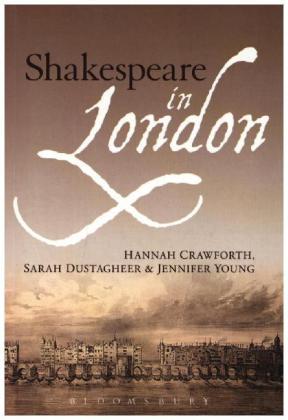
Shakespeare’s London A review

49712263Z

There’s been a growing trend of Shakespeare related books of late. Leading up his 450th birthday, authors scrambled to publish books in order to catch the wave of Bardolatry. We saw books about the man, his life, and his work. Some books were more successful than others. There was more interest in The Science of Shakespeare than there was for Shakespeare Star Wars, yet both tested critic’s views on what they were willing to accept.

The trend continues. It appears ever few months a new book is published that promises to shed new light on Shakespeare’s life or work. The authors of these books are convinced they know something others do not. While it is true, research in any field can offer new clues about a given subject, we have to be careful in assuming the connections we make between our chosen subject and what we have found are true. As I have said in past posts, it is a grave mistake to assume the connection(s) we find are evidence of some truth about Shakespeare. There is no shame in asking, “could it be?” but to say we KNOW is narcissistic speculation at best.

Tina Packer’s “Women of Will”, based a play of the same name, could have and should have been a delightful read. Packer is a director and actor who has dedicated the last 30 years to Shakespeare. Her knowledge of the theater alone would be reason enough to write a book. Yet she too falls into the “I know” trap as she talks about Shakespeare’s thoughts on women and why we wrote them as he did. Worse yet, she makes some rather bold claims about his life, as if her gut feeling is as good as factual knowledge. She claims to know who the Dark Lady is and her ‘relationship” to Shakespeare. Her claim that Shakespeare wrote Henry VI while still in school is laughable. Packer may be a brilliant director but it is fair to say that she has allowed herself to get too close to her subject. Make no mistake, Packer offers her readers insight into the world of acting, but an academic she is not.

This is why Shakespeare’s London is such a breath of fresh air. Hannah Crawforth, Sarah Dustagheer and Jennifer Young, three UK college lecturers, take us on a tour of Shakespeare’s world without a hint of “I know”. The authors point out events and social situations that might have been the inspiration for some of the plays. They make connections but never assumptions. Ironically, had they done so, I would’ve had to reassess my critical view on this sort of research. What they offer is compelling.

Each chapter is a specific view on London’s society. The first chapter is on violence, the last on economics. Every chapter opens our eyes to a new part of London society. They show us what Shakespeare would have seen and experienced. They offer tantalizing clues about Shakespeare’s world and how he may have mirrored it in his plays.

Chapter one talks about Tyburn, the city’s site for public execution. Travelers to London in Shakespeare’s day would have been greeted with the horrific sight of bodies left hanging. London’s citizens viewed public executions as part of everyday life. Hundreds stood and stared as criminals were hanged, drawn, and quartered.

These same people would think nothing of watching bear baiting and dog fighting. We don’t know if this type of spectacle was shocking to young Shakespeare but it is interesting to find out that in May of 1593 two Puritans were taken to Tyburn to be hanged. At the last minute they were reprieved, only to be taken back to prison, and hanged a week later. Shakespeare would write Titus Andronicus not long after this event. There is a scene in which it is noted that the hangman had taken someone down, “for the man must not be hanged till the next week”.

This is a very bloody play that suggests that nothing good comes from senseless violence. While we will never know why Shakespeare wrote this play, it is interesting to see how violence in the justice system and public sport could affect a writer. Learning about Tyburn and the city’s propensity to violence as a social norm was one of city’s many layers I uncovered while reading this book. To be sure this is a book about Shakespeare’s London, but it is the city, not that playwright that takes center stage.

One of the most compelling connections between Shakespeare’s work and his adopted city is the timing of The Merchant of Venice. The play was published in 1600. We don’t know how long Shakespeare took to write his plays, but even if we back it up to say, 1599, it comes close to a time in the Lord Chamberlain lives when they were struggling to find a permanent home. For a short while the players were forced to enter into an agreement with the owner of the Swan Theater, Francis Langley. He demanded the players stage no plays at any other venue; if they did they would be fined 100 pounds. Talk about demanding a pound of flesh! 100 pounds was a huge amount of money back then.

Now all of this is speculation of course, and the authors are quick to point out that while we don’t know exactly what inspired Shakespeare’s writings, we do know that we are all products of our environment. This tour of London offers readers the chance to see what kind of environment Shakespeare lived in. Take from it what you will.
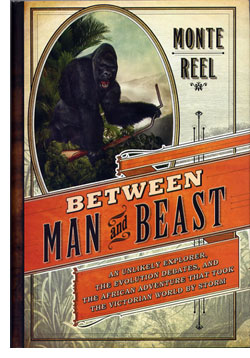
Between Man and Beast or why gorillas are not proof of Bigfoot

reel-between_man_and_beast-pgr

There is a yet again a resurgent interest in Bigfoot. No, I am not talking about American cable television’s manic obsession with the beast. Thankfully this seems to be on the wane. After 7 years, Finding Bigfoot may be gone, in large part because it has yet to find a clue, never mind an 8-foot monster. No, its now mainstream science and journalists who are jumping on the Wildman’s bandwagon.

Former Oxford Professor of genetics, Brian Sykes, put a call out for Bigfoot samples a few years back as part of a plan to conduct genetic analysis of the material. He and his colleagues called this the Oxford-Lausanne Collateral Hominid Project. What he found remains as elusive as what he was looking for. At first it was thought he found a possible hybrid bear that would explain Yeti sightings, but it turns out the sampling may have been flawed. The media, as usual ,is contradicting themselves as to his other findings. But soon, it turns out, we can all read about the project in his unnamed upcoming book on the subject. Or will we? Each day, as more and more information flows across the Internet, new questions and concerns arise. Is he really an Oxford fellow? Yes, but he has not been associated with the institution for over a decade. What is this Wolfson Institute, he claims to be a member of? Turns out, it’s mythical. Sykes says he needed more college cred, so he made up a one man Institution. Humm. I wonder if I could do that and apply for Federal funds?

Why am I bringing this up? Because not much about this is new. We’ve seen this played out before. Only last the time it wasn’t Bigfoot, it was the elusive gorilla. Yet to be fair, there is one major difference between the two: contrary to popular belief (or lies-to-adults) the early 19th century science community understood the gorilla to be fact. What they could not agree on was what kind of ape was it? What did it look like? With little more than stories and a few skulls and leg bones to go by, the community was torn.

Today many Bigfoot enthusiasts use the gorilla as their go-to story on why the search for Bigfoot ought to continue. The common view is that the gorilla was myth until African explores found and killed a few. The idea that a myth turned into fact is why I picked up Monte Reel’s Between Man and Beast. An Unlikely explorer, the evolution debates, and the African Adventurer that took the Victorian world by storm.

 images-3

Reel recounts the life and adventures of Paul Du Chaillu, the unlikely adventurer who brought back several stuffed gorillas along with bones and tales of the mighty beast.

What fascinated me wasn’t so much the adventure. It turns out it wasn’t all that hard to find and kill gorillas. But the scientific backlash that followed. Du Chaillu was the first to bring back a body and watch them in the wild, yet this did not stop the scientific community from calling him a fraud. It was unimaginable that a young, uneducated, underfunded Frenchman could have gone into the heart of Africa and shot gorillas.

As I read the book I could not help but be reminded again and again of Bigfoot hunters, the stories associated with the creature, and the lengths people will go to in order to ingratiate themselves into the myth of the beast. Some find it hard to believe that so many would lie about seeing such a creature. Reel’s book shows us that is a very human and often repeated human trait.

Early on in the book, as Du Chaillu first sets out to find the Gorilla, his guides tell him what we would now describe as campfire stories. In one of these stories a gorilla chases two women. One gets away, the other does not. The tribe, thinking the second woman has been eaten, is surprised upon her return. She claimed (so they say) to have been raped by the gorilla, “leaving her traumatized but otherwise unharmed”. (52) Other native stories tell of how gorillas are possessed by human spirits. In fact, spirit possession was part of the early native gorilla lore. The spirits of dead warriors inhabited gorillas and because of this, these supernatural man/apes could not be killed. Anyone who knows anything about Native American Wildman lore can see the similarities. Anyone who has read accounts of encounters with Bigfoot have read accounts of women who claim to have been raped by the beast.

You and I have probably never heard of Charles Waterton, but all of Victorian England would have known him quite well. He was a rival of John James Audubon. Both were naturalists specializing in birds, but Waterton, not content to specialize in just one thing, credited himself with discovering several species including the gorilla. Not having anyway of proving it didn’t stop him from telling stories about his adventures with the gorilla. He even claimed to have kept one as a pet, which is odd since no one ever saw it or its corpse. It was Waterton who led the charge against Du Chaillu. Waterton was an egomaniac who wanted the spotlight for himself. Perhaps on some level he believed his own stories. Yet the question I asked myself as I read this book is why, if he wanted to be the one to discover the gorilla, didn’t he? After all it turns out gorilla bones were easily attainable.

It was the first and last time I was ever on a Cayman's back" From Waterton's book Adventures in the Amazon 1825
It was the first and last time I was ever on a Cayman’s back” From Waterton’s book Adventures in the Amazon 1825

Before Du Chaillu stepped off the boat into the heart of the African jungle, he put a call out for gorilla bones and skulls. He had promised the Philadelphia Natural Society (who promised to fund his expedition) he would send ship bones to them. His request from the natives resulted in a return of so many bones that he quickly stopped paying for them. Let that sink in for a moment. Before the first white man ever set eyes on a gorilla, the creature was already a well-documented fact. Bones had been coming out of Africa for several years. They had physical proof that it existed. What the scientific community didn’t know was what the creature looked like or what he ate. Contrast this with Bigfoot. Men have been hunting him for almost 100 years, and yet not one bone has been found. There is no physical proof, yet the tie between finding Bigfoot and finding a gorilla remains. Hunters continue to use the story of the “elusive” gorilla as proof of an elusive Bigfoot.

Du Chaillu’s adventures into Africa are only a fraction of the story. In less than two months he had spotted and killed two gorillas. Let that sink in Bigfoot hunters. Europeans had some physical proof of the beast. When someone decided to brave the African interior with the sole purpose of finding a gorilla, it took just a few months to do so.

The real drama of the story played out within the scientific community as they battled to decide how the gorilla fit into their worldview. Was this proof of co-evolution or was this proof that man deserved a special place among other species? The battles between those who risk their lives to bring back new species and those who worked to qualify and classify them could be very ugly. Add into this volatile mix were dissenting voices from armchair adventurers, seeking to snatch the glory for themselves.

Reel’s book is a fascinating account of the ugly side of science normally hidden from view. The book gives Du Chaillu, a man who is lost to history, long overdue credit for bringing back not just gorillas but inspiring other adventures and writers. If it were not for Du Chaillu, Author Conan Doyle would never have thought to write The Lost World, nor Jack London Call of the Wild. Both men read and credit Du Chaillu’s book Adventures and Explorations, as their inspiration.

Isn’t it funny how some things never change? Once again we have an elusive beast in which stories of rape and spirit possession abound. The scientific community is all too eager to discredit anyone who claims to have proof of its existence and many armature explorers will do just about anything (including making fools of themselves on TV) to be the first to bag the beast. The difference of course is that this time there is no physical proof that makes this a worthwhile endeavor. Or is there? Professor Sykes, we wait on you, claws extended.

Amazing Waste

Repurposing Food and Reducing Waste

measurestillformeasure

Shakespeare, Classics, Theatre, Thoughts

Nerd Cactus

Quirky Intellect for the Discerning Nerd

Sillyverse

Stories of magic and mystery

Commonplace Fun Facts

Mind-Blowing Facts You Didn’t Know

Fictionophile

Fiction reviews, Bookblogger, Fiction book reviews, books, crime fiction, author interviews, mystery series, cover, love, bookish thoughts...

Patrick W. Marsh

I write literary horror - poems, short stories, and books

Shakespeare for Kids Books

Opening the door for kids to love Shakespeare and the classics

desperatelyseekingcymbeline

The 10-year Shakespeare New Year Resolution

Katzenworld

Welcome to the world of cats!

booksandopinions.com

The Book Reviews You Can Trust!

The Book Review Directory

For Readers and Writers

thelitcritguy

screams from the void

Author Adrienne Morris

Step Into the Past—Lose Yourself in the Story.

crafty theatre

ideas inspired by crafty characters

Critical Dispatches

Reports from my somewhat unusual life

The Nerd Nebula

The Nucleus of the Universe for all Nerd Hacks!