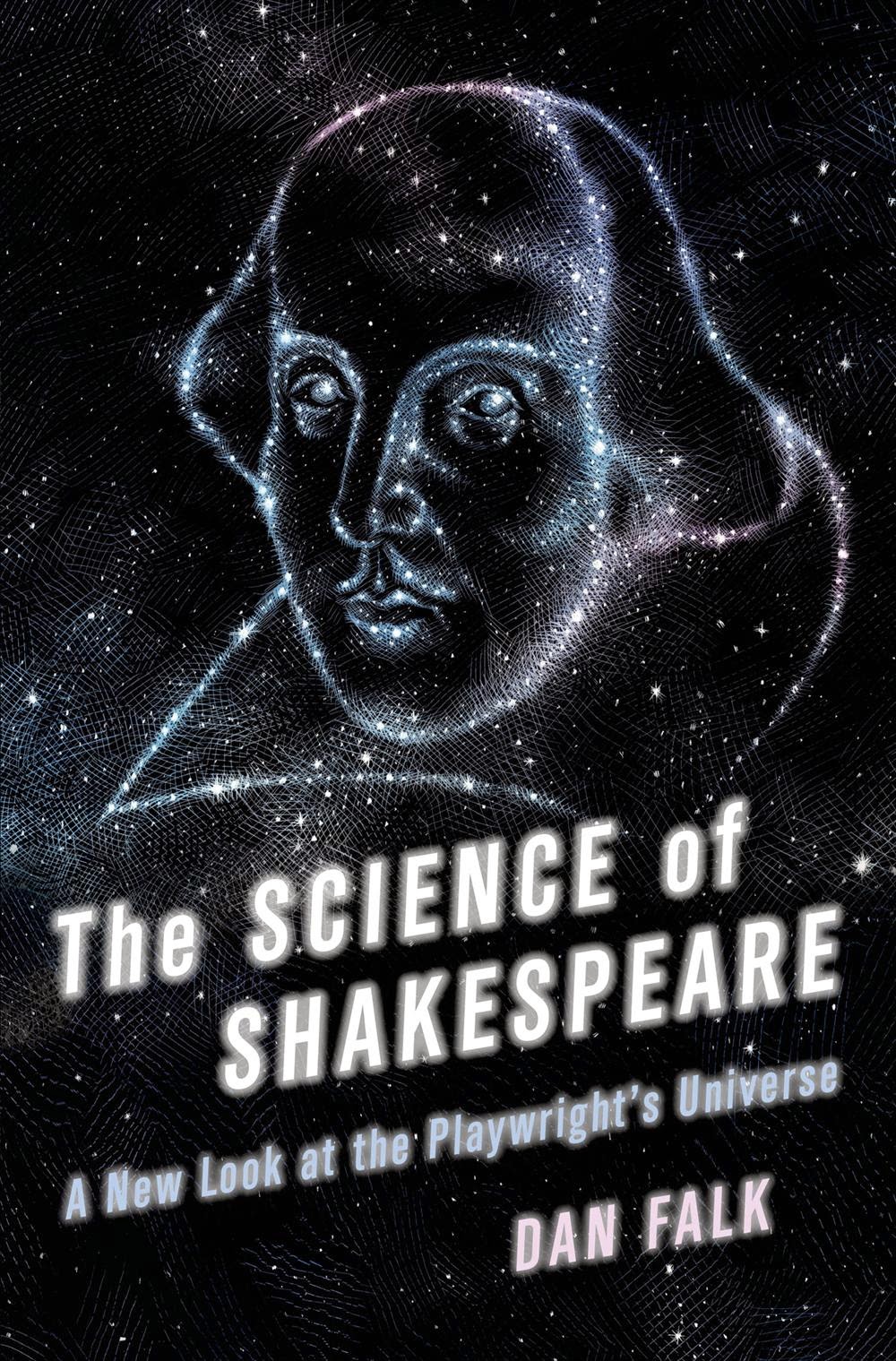
The Science of Shakespeare, a review

Science+of+Shakespeare,+The

In 1996, during a meeting of the American Astronomical Society astronomer Peter Usher presented a usual paper titled “A new reading of Shakespeare’s Hamlet”. In the paper Usher argued that Hamlet was written as an allegory about competing cosmological models. It is always a little alarming whenever someone announces they’ve peered into Shakespeare’s mind and unlocked its secretes, but in this case Usher’s paper begged a very good question: what, if any influence did science have on Shakespeare’s work?

Dan Falk tries to answer this question in his tour de force, The science of Shakespeare. Falk reminds us that,“William Shakespeare lived at a remarkable time—a period we now recognize as the first phase of the Scientific Revolution. New ideas were transforming Western thought, the medieval was giving way to the modern, and the work of a few key figures hinted at the brave new world to come: The methodical and rational Galileo, the skeptical Montaigne”. The obvious question is, did any of this have an impact on Shakespeare’s writing? If so can we find hints of scientific ideas in Elizabethan pop culture?

From the very start Falk admits to be walking a thin line. It’s one thing to analyze Shakespeare’s work in order to form an opinion on what he might have thought; it is another to conjecture based on one’s own thoughts. That an astronomer thinks Hamlet is some sort of scientific thesis should gives us pause. Yet Falk is open to the idea that Shakespeare was indeed influenced by the events and people around him and that this influence is peppered through out the plays.

Does Falk present a convincing argument? I think so. First, we have to admit that it is not unusual for a writer to be influenced by current events and public figures. Shakespeare would not have such a lasting impact on us if he had not commented on society. Yet this idea of science in Shakespeare shows us that there is more going on than just simple acknowledgment of the changing times. Drawing on new ideas and discoveries, Shakespeare may be telling us how they affected society. After all, his audience would have to have some basic understanding of them in order to understand his words.

Falk makes his case by introducing us to some of history’s most compelling thinkers. Men like Thomas Digges, the publisher of the first English account of the “new astronomy” and who just happened to live in the same neighborhood as Shakespeare; Tycho Brahe, whose observatory-castle stood within sight of Elsinore and whose family crest happened to include the names “Rosencrans” and “Guildensteren (did you know that? I didn’t) and my favorite (I have to thank Falk for introducing him to me) Michel de Montaigne, a skeptical thinker whose motto Que sais-je? (What do I know), mirrors my own. Falk shows us how each of these men and others, in one way or another influenced Shakespeare’s work.

Take for instance, Montaigne. His essays on his thoughts on life and the universe clearly show up in Shakespeare’s The Tempest. Montaigne talks about a group of Tupinamba people who were brought to France by French explorers. He writes:

It’s a nation….that hath no kind of traffike, no knowledge of Letters, no intelligence of numbers, no name of magistrate nor politke superiorite; no use of service, or riches or of poverty…”

Now take Gonzalo’s view of a utopian society:

I’th’ commonwealth I would by contraries

Execute for all things, for no kind of traffic

Would I admit; no name of magistrate;

Letters should not be known; rich, poverty

And use of service none.

This does not prove Shakespeare argued for a utopian society, but it does show us that he was reading and thinking about recent publications and events. As I read this I wondered if The Tempest was indeed a critical allegory to colonization, and if so, was it Montaigne who planted the seed of doubt in Shakespeare’s mind?

Around 1610, Galileo’s book, The Starry Messenger was a hot topic in English intellectual society. The book sold out. Thomas Hobbes had a hard time getting his hands on a copy. Galileo’s observation of Jupiter’s four “satellites” showed that Copernicus’ model of a heliocentric universe just might be right after all.

This had to be big news and to ignore it would be to ignore the changing views of our place in the universe. Shakespeare could have written a play about this had it not been controversial and a little boring for two hour play, but instead seems to have planted the idea in a convoluted scene in Cymbeline. In the scene, Posthumus, finds himself jailed. In his cell Posthumus has a dream in which four ghosts visit him and move around him in a circle. They call upon the god Jupiter to help him. Humm.. four satellites and the god Jupiter? This is either an odd coincidence or Shakespeare’s way of introducing his audience to idea of this discovery.

Of course we will never know. Though the book is filled with more examples, some more convincing than others, Falk never makes the claim that these are proof that Shakespeare used science. We are left to form our own opinions. This is one of many reasons this is a compelling read. Falk explores many theories on Shakespeare and science, yet rarely comments on them. The one exception may be his agreement that Prospero may be based on Thomas Digges rather than John Dee. I do not agree, for the simple reason Dee was both a man of science and a magician who claimed to talk to the angel Uriel (just as Prospero talked to Ariel).

If nothing else this is a wonderful look at the history of science and the men who brought about the scientific revolution. It had me questioning some of the modern assumptions about Shakespeare’s work. It just might be my choice for best read of 2014.

If it Wasn’t for Shakespeare…Lists!

shakespeare-birthday_1397451905

Today we celebrate Shakespeare’s 450th birthday. We do this even though historians are not quite sure this is his date of birth. What we do know is that he was baptized on April 26, 1564. Normally newborns were baptized three days after being born. He died on April 23, 1616, so April 23 is dedicated to the Bard.  And what better way to celebrate his work than with lists?

Polonius asked Hamlet, “What do you read, my lord? Hamlet replies “Words, words, words.

You my dear readers are going to read lists lists lists!

Harold Bloom, the great philosopher and Shakespearean critic, once said, “Shakespeare invented the human”. I would not go so far, but I would say that Shakespeare invented how we looks at the human condition. His characters are mirrors in which we can all look into and see a part of ourselves. But, be careful how you judge his work. Bloom reminds us, “How you view Shakespeare’s characters may say more about you than it does about him”.

Here is a quick list of some of his more famous humans:

Hamlet:

Hamlet has been called the man who could not make up his mind. He is tasked with avenging his father’s death, yet, while having no qualms about killing his traitorous friends, and lashing out with a sword in a murderous rage, he hesitates when it comes to killing Claudius. In act 3, scene 3, Hamlet comes across Claudius as he is praying. Claudius is alone and unarmed. Hamlet says, Now might I do it pat, now he is praying; And now I’ll do’t. And so he goes to heaven; And so am I revenged. That would be scann’d: A villain kills my father; and for that, I, his sole son, do this same villain send to heaven. O, this is hire and salary, not revenge. Hamlet realizes that by murdering Claudius while his uncle prays, his soul may find its way to heaven. This is not what Hamlet wants, yet it is the only opportunity Hamlet will have to dispatch his uncle. Because he hesitates, tragedy ensues. Hamlet sees and speaks to his father’s ghost who informs him of Claudius’ betrayal. Of how Claudius killed him, seduced his widow and stole the crown. The crown that is rightfully Hamlet’s. Yet even as he witness to his uncle’s usurpation, Hamlet needs more proof before he will act. In Act 2, scene 2 Hamlet comes up with a plan that will help him discover the truth. Murder has no tongue, but miraculously it still finds a way to speak. I’ll have these actors perform something like my father’s murder in front of my uncle. I’ll watch my uncle. I’ll probe his conscience and see if he flinches. If he becomes pale, I know what to do. The ghost I saw may be the devil, and the devil has the power to assume a pleasing disguise, and so he may be taking advantage of my weakness and sadness to bring about my damnation. I need better evidence than the ghost to work with. The play’s the thing to uncover the conscience of the king.

Hamlet doubts his own existence, and wonders, what’s the use of it all? He is hesitant when it comes to suicide. He cannot decide whether this is a good idea any more than he can decide if killing Claudius is the right thing to do.

To be, or not to be? That is the question—

Whether ’tis nobler in the mind to suffer

The slings and arrows of outrageous fortune,

Or to take arms against a sea of troubles,

And, by opposing, end them? To die, to sleep—

No more—and by a sleep to say we end

The heartache and the thousand natural shocks

That flesh is heir to—’tis a consummation

Devoutly to be wished! To die, to sleep.

To sleep, perchance to dream—ay, there’s the rub,

For in that sleep of death what dreams may come

When we have shuffled off this mortal coil,

Must give us pause. There’s the respect

That makes calamity of so long life.

For who would bear the whips and scorns of time,

Th’ oppressor’s wrong, the proud man’s contumely,

The pangs of despised love, the law’s delay,

The insolence of office, and the spurns

That patient merit of th’ unworthy takes,

When he himself might his quietus make

With a bare bodkin? Who would fardels bear,

To grunt and sweat under a weary life,

But that the dread of something after death,

The undiscovered country from whose bourn

No traveler returns, puzzles the will

And makes us rather bear those ills we have

Than fly to others that we know not of?

Thus conscience does make cowards of us all,

And thus the native hue of resolution

Is sicklied o’er with the pale cast of thought,

And enterprises of great pith and moment

With this regard their currents turn awry,

And lose the name of action.—Soft you now,

The fair Ophelia!—Nymph, in thy orisons

Be all my sins remembered. (3.1)

In the end all of his doubts just give Claudius time to plan Hamlet’s death. Every major character dies because Hamlet cannot make up his mind. He is so busy second guessing every move he misses major opportunities. In this we can see that often we too are Hamlet. We may never contemplate killing someone, but how often have opportunities past us by because we cannot make up our minds? Sometimes we too feel we have no control over our lives and allow fate to dictate what happens to us.

Lady Macbeth:

Lady Macbeth wants more out of life than a mere drafty castle in a Scottish outpost. She and her husband plot to kill King Duncan and take the crown by force. After the deed is done she quickly regrets her actions. The horror of what they have done seeps into her conscious like the king’s blood seeping onto the floor. Yet who would have thought the old man to have had so much blood in him (Act 5 -1). She begins to sleep walk and tries in vain to wash the blood from her hands. Out damn spot. Out I say! (Act 5-1)

She cannot live with what they have done and takes her life. I first read about Lady Macbeth in high school and the two lessons I took from her were:

  1. Be careful of what I wish for. I might not be able to handle it.
  2. Never do anything that will I will regret to the point of it taking control of my life.

It has been noted that the more successful we get, the more we lose sleep, the more we are unhappy with our lives. Too our horror we find that money and success do not equal happiness or contentment. We become like Lady Macbeth, and begin to regret all that we have done. She shows us the error of our ways when we substitute power for serenity.

Henry V

Henry V is a man of action, but it is his words that we hear (we never see the battle of Agincourt) that compel others to war and love. He talks his troops into war and he talks the French princess into falling in love with him. He is a reminder that words are just as powerful as action and that we should be wary of men with silver tongues.

Once more unto the breach, dear friends, once more;
Or close the wall up with our English dead!
In peace there’s nothing so becomes a man
As modest stillness and humility:
But when the blast of war blows in our ears,
Then imitate the action of the tiger;
Stiffen the sinews, summon up the blood,
Disguise fair nature with hard-favoured rage;
Then lend the eye a terrible aspect.
(3.1.1)

Shakespeare Invents words

Words Shakespeare gave us.

Shakespeare invented 1700 words.. Shakespeare has been credited for inventing single words that normally would have taken several to mean the same thing. I won’t list them all, but here is a partial list of words we use today:

  • auspicious
  • baseless
  • bloody
  • castigate
  • control (noun)
  • countless
  • courtship
  • critic
  • critical
  • dishearten
  • dislocate
  • dwindle
  • eventful
  • exposure
  • fitful
  • frugal
  • generous
  • gloomy
  • gnarled
  • hurry
  • impartial
  • lapse
  • laughable
  • misplaced
  • monumental
  • obscene
  • First folio

My personal favorite books on Shakespeare:

Shakespeare, the invention of the Human by Harold Bloom

Shakespeare’s World by DL Johanhak

Shakespeare by Michael Woods

How Shakespeare Changed Everything by Stephen Marche

A Readers guide to Shakespeare, by Joseph Rosenblum (I have been lucky enough to learn at this man’s feet. He is a master when it comes to understanding Shakespeare).

And thanks to No Sweat Shakespeare we can end with a list of fun Shakespeare facts:

Shakespeare is always referred to as an Elizabethan playwright, but as most of his most popular plays were written after Elizabeth’s death. He was actually more of a Jacobean writer. His later plays also show the distinct characteristics of Jacobean drama.

Almost four hundred years after Shakespeare’s death there are 157 million pages referring to him on Google. There are 132 million for God.

There are only two Shakespeare plays written entirely in verse: they are Richard II and King John. Many of the plays are a mix of verse and prose. The Merry Wives of Windsor is the only play that is almost entirely in prose.

Shakespeare’s shortest play, The Comedy of Errors is only a third of the length of his longest, Hamlet, which takes four hours to perform.

All of Uranus’ 27 satellites are named after Shakespearean characters.

Ophelia, Bianca, Cressida, Desdemona, Juliet, Portia, Rosalind, Cupid, Belinda, Perdita, Puck, Mab, Miranda, Ariel, Umbriel, Titania, Oberon, Francisco, Caliban, Stephano, Trinculo, Sycorax, Margaret, Prospero, Setebos, Ferdinand.

Among the 80 languages Shakespeare’s works have been translated into, the most obscure must be the constructed language of Star Trek’s Klingon. Hamlet and Much Ado about Nothing have both been translated as part of the Klingon Shakespeare Restoration Project by the Klingon Language Institute.

Happy Shakespeare Day!

Amazing Waste

Repurposing Food and Reducing Waste

measurestillformeasure

Shakespeare, Classics, Theatre, Thoughts

Nerd Cactus

Quirky Intellect for the Discerning Nerd

Sillyverse

Stories of magic and mystery

Commonplace Fun Facts

Mind-Blowing Facts You Didn’t Know

Fictionophile

Fiction reviews, Bookblogger, Fiction book reviews, books, crime fiction, author interviews, mystery series, cover, love, bookish thoughts...

Patrick W. Marsh

monsters, monsters, everywhere

Shakespeare for Kids Books

Opening the door for kids to love Shakespeare and the classics

desperatelyseekingcymbeline

The 10-year Shakespeare New Year Resolution

Katzenworld

Welcome to the world of cats!

booksandopinions.com

The Book Reviews You Can Trust!

The Book Review Directory

For Readers and Writers

thelitcritguy

screams from the void

Author Adrienne Morris

Step Into the Past—Lose Yourself in the Story.

crafty theatre

ideas inspired by crafty characters

Critical Dispatches

Reports from my somewhat unusual life

The Nerd Nebula

The Nucleus of the Universe for all Nerd Hacks!