Just in time for winter A quick guide to Shakespeare illustrations online

It’s been almost a week since a large winter storm hit Northern Nevada. 2005 was the last time we experienced this much snow and rain and I had hoped to never see this much again. I saw a great meme the other day on Facebook that rather nicely sums up what we are going through.

xss2x

Yes, winter is here, so it’s time to curl up and thankful for central heating. But what to do on these long winter nights when we find ourselves cooped up in the house. There is only so much one can do at home without going a little stir crazy. Thank goodness for the Internet.

The other night I found myself looking for Shakespeare related news and came across a Tweet mention by Folger’s Library. The tweet invited readers to check out the Victorian Illustrated Shakespeare Archives by Michael John Goodman https://shakespeareillustration.org/ It is a blog devoted to the cataloging of Victorian illustrations found in various works of Shakespeare. Thanks to the Romantics, there was a wave of early Victorian populism in Shakespeare publishing, but unlike the multitude of “subject’ books we see today, these books simply reproduced the plays and added their own artistic flare by including illustrations. Goodman has taken it upon himself to archive and catalog many of these pictures.

While I admit the undertaking is ambitious, the execution is lacking. The front page gives no bio or reason why this concordance of illustrations was created Was it a school project, or the work of a Shakespeare loving coder?

The header is broken up by Victorian illustrators while the body is cataloged by theme. I do not want to be the first to tell Goodman, but the works by the illustrator Kenny Meadows has Pericles housed in the comedy section. It’s a slight mistake given the work that must have gone into making this site, but it would throw off a person who is unfamiliar with Shakespeare’s work. The mistake is further compounded when one clicks on the Comedy theme in the body of the first page. Clicking on comedy takes you to pictures found in Pericles. You would think this mistake would have been found right way because of this.

Clicking on a picture gives you bare-bones information about the history of the picture. An example would be here, in the picture Benedict listens in.

Source Text: The Works of Shakespeare / Edited by Howard Staunton / The Illustrations by John Gilbert / Engraved by the Dalziel Brothers / Vol. I

Staunton? Who is Staunton? So much for him.

The pictures Goodman includes tell us less about Shakespeare and more about Victorian illustrators. Often the pictures tell their own story, as each expand upon a particular scene and widen our view of it. Other times the illustrators simply takes a character and draws them just for the sake of drawing them. Why Kenny Meadows paired Cleopatra and cherub we may never know. It would have served Goodman and his viewers better had he included some historical perspective.
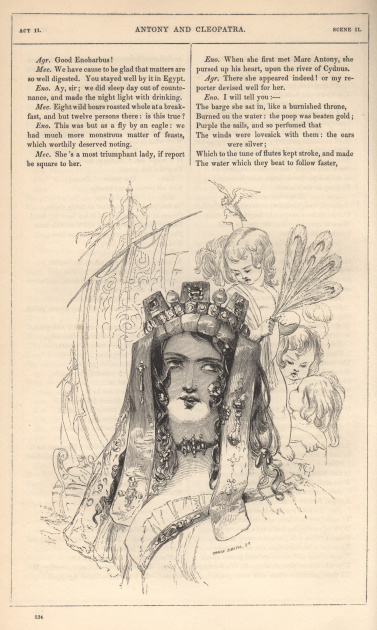
Cleopatra and cherub Illustrator: Kenny Meadows Engraver: John Orrin Smith Original Illustration Size: 155 x 115 mm / 6″4 x 4″16 Illustration Number: 9/19
Cleopatra and cherub Illustrator: Kenny Meadows
Engraver: John Orrin Smith
Original Illustration Size: 155 x 115 mm / 6″4 x 4″16
Illustration Number: 9/19

It would have been nice had Goodman included some history of the book, even if that history was repeated in every picture from the book. Goodman doesn’t bother to guide us through his collection or offer any assistance to further reading. I was somewhat irked by Goodman’s only comment on the site. He has a very long winded paragraph on how to cite his work. Reading the paragraph it is clear he is no scholar as his views on citing have more to do with making sure he is given proper acknowledgment than how to properly cite a source. I hope I have given him his deserved credit.

For a better site and historical look at Shakespeare themed Victorian illustrations I would suggest heading to Open Source 3,000 Illustrations of Shakespeare’s Complete Works from Victorian England, Neatly Presented in a New Digital Archive

tempest-kmtemp41-1
Here you will find some very wild illustrations, many with a short bio or comment. Take this picture from the Tempest. Open Source tells us,

“The Knight’s edition is joined by one from Kenny Meadows, who contributed some very different illustrations to an 1854 edition. Just above, see a Goya-like illustration from The Tempest”.

I love the Goya-like reference to this picture. It told me I might not have been the first to mutter, “WTF?” when I first saw it.  Open Source takes the time to comment and offer some history of the works presented. Be warned, this is an addictive site, perfect for a warm winter weekend viewing.

the-first-illustrated-works-2302_b_14_vol1_frontispiece
For those who love online collections, no post is complete without mentioning the British Library’s Collections The First illustrated works of Shakespeare edited by Nicholas Rowe, 1709  The BL must be commended for making so much of its content freely available. If you love museums and books, this is a dream come true.

I don’t know about you, but I plan on sitting down with a a pot of tea and looking at all 3,000 Shakespeare inspired illustrations. With so much vitriol over ,and about the Internet these days, sites like these are nice reminders that there is more to it than just “fake news” and platforms for narcissistic personalities.

Works Referenced and Cited

British Library Collections The First illustrated works of Shakespeare edited by Nicholas Rowe, 1709 Online. No date given.  https://www.bl.uk/collection-items/the-first-illustrated-works-of-shakespeare-edited-by-nicholas-rowe-1709.

Goodman. Michael, John. Victorian Illustrated Shakespeare Archives by Michael John Goodman. Online 2016 https://shakespeareillustration.org/. (that, Micheal, is how you site a source)

Open Source 3,000 Illustrations of Shakespeare’s Complete Works from Victorian England, Neatly Presented in a New Digital Archive. Online. No date given. http://www.openculture.com/2016/09/3000-illustrations-of-shakespeares-complete-works-from-victorian-england.html
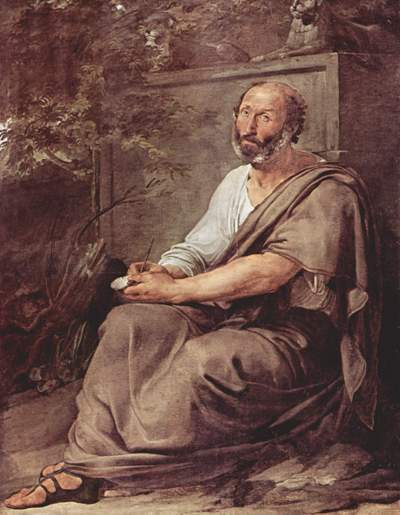
Aristotle and Shakespeare on tragedy

I think this painting of Aristotle looks a little like Shakespeare

As part of my graduate studies I was assigned various contemporaries of Shakespeare, and of those whose came after him, but for some unfathomable reason we were never assigned Aristotle. This is a shame because his lectures, gathered together in a book titled Poetics, is the blueprint for Shakespeare’s tragedies. In my mind it is a must read for any student of Shakespeare.

I just recently picked up the book after reading a reference to Aristotle’s criticism on Greek theater. I am very familiar with Aristotle as a philosopher, having studied philosophy as an undergrad, but had never heard of his work as it relates to drama. I suppose this work should come as no surprise as Aristotle had an opinion on everything from biology to the supernatural.

Eugene Garver, editor of Barnes & Noble’s edition of Poetics tells us:
Tragedy came into existence in Athens along with democracy in the late sixth century. Performing and watching a tragedy were political acts, part of the celebration of a festival in honor of the god Dionysus.

Aristotle, being politically minded, reflected on tragedy in drama precisely because it was every man’s civic duty to engage in this type of theater. In fact in Aristotle’s day the theaters of Athens could easily hold 3,000 people. All men were expected to attend; the young men about to enter into military duty served as the chorus, while the war veterans served as the audience. No mention if women were expected to attend.

For the Greeks, tragedies served a duel purpose; they brought the citizens together to share a common experience, and in sharing that experience, were collectively learning a valuable life lesson. A reminder that character flaws led to the downfall of society. Part of the glue that held society was the idea that all things achievable should be done for the greater good. The Greeks had a name for those who whose achievements served only themselves; Pleonexia, which translates to mean “over-reaching ambition or greedy”. It was thought that the Gods punished these people, as pleonexia was a vice that they would or could not over-look. So tragedies served as imitations (Aristotle’s word) to warn men not to succumb to this vice. Aristotle expanded on this idea and outlined what made for a good tragedy.

Aristotle’s formula for tragedy

Tragedies have to contain a unity of time, place and action. The action should take place within a single 24-hour period.

The plot is the soul of the tragedy. Characters are dimensions of the object of imitation, and are subordinate to the plot. The plot drives them, though it is their flaw that allows this to happen.

Tragedy has a beginning, a middle, and an end,and has to contains a discovery and reversal.

Tragedies are caused by a tragic flaw, which is done by a tragic hero.

The experience of a tragedy causes a catharsis, the purging of pity and fear.

This list is important to Aristotle because in his words, “Knowing what kind of thing a given work of art is enables you to know what is essential and critically important to it and its evaluation”.

In my mind, this is genius take on all most all forms of literature. How many times have you watched or read something, not as it was meant to be presented, but through your personal bias and thought, “Oh this is crap”? It goes against how we usually experience art, yet it makes perfect sense! When we evaluate something we do so through our own personal experiences and expectations. Aristotle tells us to look at a piece for what it is supposed to represent, and evaluate it to see if it has elicited the proper response.

Shakespeare may not have kept to Aristotle’s list, but he was the master at making sure his tragedies provoked the proper response. He used a lot of what Aristotle had to say about tragedies, and to some extend, comedies in order to achieve a certain respones. Aristotle divided the two thusly: Tragedies depict people who are better than we are, while comedies represent people who are worse. This may seem harsh, but when is the last time you saw a Hollywood comedy based on wealthy people? True, modern tragedies can depict the every man, but in every case, the man in question is noble but flawed.

Shakespeare’s England was not democratic. As the country leaned towards Protestantism, Catholic morality plays gave way to drama as a pure form of entertainment. It was up to the English playwrights to look beyond religious lessons and define what made for a good play. Society was suspect of actors and playwrights; they were deemed by many to be immoral and spiritual corrupt, so it made sense that writers like Johnson, Marlowe, and Shakespeare made use of tragedy as a new form of morality plays. Getting superstitious people to fill play houses night after night may have been easier if they thought they may experience some type religious lesson. The beauty of Shakespeare’s tragedies is that everyone can identify with his flawed characters, though each are “better than we are”.

Shakespeare drew on the human condition that we all suffer from, and gave his characters flaws that mirror our own. Othello’s passionate nature surprises even him, and he is unable to fully understand and control this new emotion. Macbeth is ambitious and cannot find where to draw the line. Lear is too rash and is in serious need of some self-awareness. Hamlet is too melancholic and wrapped up in his own head; so much so that he reacts impulsively to each new situation. And though Juliet admits her love and marriage to Romeo is “is too rash, too unadvised, too sudden”, she is swept up in her emotions and allows them to rule her mind. We’d be dishonest if we didn’t admit to feeling a few of these emotions ourselves.

If we view Shakespeare’s tragedies for what they are, we can begin to appreciate the emotional impact he was aiming for. We may even experience catharsis, in that we are able to experience the suffering of flaws without a personal loss. We experience the purging of pity once the play is over, and if open to a lesson, may purge a fear that we too could suffer the same fate.

After reading Poetics is seems evident that this was a book also read by Shakespeare. You can almost hear Aristotle point towards Shakespeare when he talks about the proper use of language, “By language embellished, I mean language into which rhythm, harmony and song (meaning verse) center”. Because Shakespeare used Greek mythos in many of his works, one could take Aristotle’s examples and substitute them with characters found in Shakespeare’s plays.

I am not sure Aristotle would have approved of everything Shakespeare did with his formula but in the end I have to think that even he would approve of the plays outcome, provided he could take his own advice and evaluate them on for what they are supposed to be. It would be tragic if he could not.

Works Cited

Aristotle ,Poetics. Barns & Noble Press
Garver, Eugene, Intro to Poetics. Barns & Noble Press
Shakespeare, William, Romeo & Juliet. Folgers Press

Amazing Waste

Repurposing Food and Reducing Waste

measurestillformeasure

Shakespeare, Classics, Theatre, Thoughts

Nerd Cactus

Quirky Intellect for the Discerning Nerd

Sillyverse

Stories of magic and mystery

Commonplace Fun Facts

Mind-Blowing Facts You Didn’t Know

Fictionophile

Fiction reviews, Bookblogger, Fiction book reviews, books, crime fiction, author interviews, mystery series, cover, love, bookish thoughts...

Patrick W. Marsh

I write literary horror - poems, short stories, and books

Shakespeare for Kids Books

Opening the door for kids to love Shakespeare and the classics

desperatelyseekingcymbeline

The 10-year Shakespeare New Year Resolution

Katzenworld

Welcome to the world of cats!

booksandopinions.com

The Book Reviews You Can Trust!

The Book Review Directory

For Readers and Writers

thelitcritguy

screams from the void

Author Adrienne Morris

Step Into the Past—Lose Yourself in the Story.

crafty theatre

ideas inspired by crafty characters

Critical Dispatches

Reports from my somewhat unusual life

The Nerd Nebula

The Nucleus of the Universe for all Nerd Hacks!