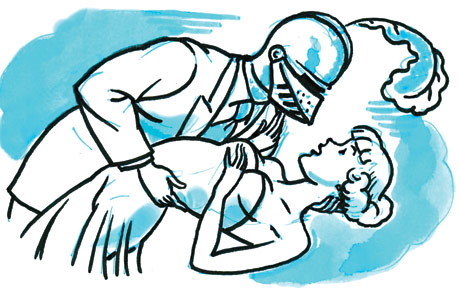
Hamlet: Does he or doesn’t he?

imgHamlet1

Shakespeare purists hate modern adaptations of his plays. I tend to fall into this camp. One of my major pet peeves is the liberal use of scene shifting directors seem to believe is their right. Worse yet is when they cut scenes out all together! Gregory Doran who directed David Tennant in 2009 did both badly, and I have yet to forgive him for it. As did Olivier in 1949. He took a 4-hour play and condensed it down to 2, cutting all mention of Rosencrantz and Guildenstern.

There is a good argument against adaptation. The one that springs to mind is how we modern audiences have come to believe Hamlet may have been more than a little jealous of his stepfather. Thanks to Freud’s view that every son secretly wants to bed his mother, almost every director since Olivier has made Hamlet the Oedipal son.

In the bedroom/sitting room scene between Hamlet and his mother he says to her, “Come, sit you down; you shall not budge”. He never drags her to her bed and rages at her as he straddles her. Yet this is how we usually see it played out.  If you watch the Zeffrelli adaptation like I did (again) last night, be prepared to feel very uncomfortable as Mel Gibson dry humps Glenn Close while he rages. Seriously, I almost stopped the film to take a shower, it felt that dirty.

Yet as much as we purists want to see Shakespeare as he intended it, we have to admit there may be much we can learn about the plays if we let go of our outrage and simply watch what is being presented to us. Often an actor’s interpretation of the character he or she is playing can cause us to reexamine our own interpretation and lead us to look at the plays in new and exciting ways.

Is Hamlet so depressed “he cannot make up his mind to act” as Olivier is so often quoted as saying. Or does he hesitate in killing Claudius because he is not sure the ghost is his father’s spirit as Tennant wondered? Both views seem right and since we do not have Shakespeare’s notes, we will never know, but it is fun watching the different takes on the prince and why it is he comes to such a tragic end. If he could have acted instead of reacted things may have turned out differently.

But interpretation is not the same as adaptation and as I mention before, adaptation changes the original theme of Shakespeare’s plays. Yet as I watched the Zeffrelli film last night an idea came to me. An answer to an question still debated among Shakespeare scholars; “Does Hamlet love Ophelia or not?” There are many examples of his love for her; his letter to her stolen by Polonius, that I think is the most romantic piece of literature, “Doubt thou the stars are fire. Doubt that the sun doth move, doubt truth to be a liar; but never doubt I love”.  His moving speech at her graveside, “I loved Ophelia. Forty thousand brothers could not with all their quantity of love make up my sum”. Yet there are also the fact that he mocks her maidenhood in front of an audience and the famous “get thy to a nunnery” speech in which he tells her he never loved her and accuses her of “wantonness and ignorance”.

So does he or doesn’t he love Ophelia? From my many courses and readings of Shakespeare I have learned two things; Shakespeare never lies. He never has the audience believe one thing only to have the opposite be true. Oh sure, characters lie to each other, but never to the audience. We know who Rosalind is even as she disguises herself, just as we know Iago is not to be trusted even as the other characters call him “honest”. The other thing I have learned is that each sentence is a thought and together these thoughts make up ideas. Shakespeare was the master of one-line thoughts. If we have questions about what is going on in his plays we need to look at each of his sentences to find our answers.

So all of this brings me to an epiphany of sorts; one that came to me as I watched Zeffrelli’s adaptation. He broke the famous nunnery speech in two.  The second part went like this, “What should such fellows as I do crawling between earth and heaven? We are arrant knaves all: believe none of us. Go thy ways to a nunnery. Where is your father”? As Gibson uttered these lines he paused and said softly “believe none of us” and looked at Ophelia with longing and regret. It hit me; this line that so many actors spit out in anger is a separate thought. He is asking her at that very moment not to believe a word he is saying. He does love her and everything he is saying right then is not to be trusted. Unfortunately for Ophelia she does not get his meaning and apparently neither do Shakespearean scholars for nowhere in their arguments can I find any hint that this line stands out. So maybe I am wrong, but I don’t think so. I read the speech again today and cannot find any other reason Hamlet would include this in his hurtful speech. We have to remember Hamlet is aware that Polonius is listening. Hamlet’s back is to the wall. He has to act mad, but not mad with love as to keep the King guessing as to what is going on with him. He must abuse poor Ophelia, but in his abuse is a coded message. A message that, at least for me, answers the question; yes, Hamlet does love Ophelia. The letter came from his heart, as did the graveside speech.

Tell me what you think. Am I on to something here? I ‘d also love to hear about your favorite Shakespeare film. Perhaps there is more to learn from adaptations.

Courtly Love, why we still hold on to this idealized form of love

picg2xI promised myself I would read at least two history books a month, and, knowing this would be a busy time for me, I picked up two small books both on the subject of Courtly Love.

We are all familiar with love at first sight and the noble suffering that it can bring. Some of us have been lucky and experienced it while for many it is something that only happens in movies and books. The plot goes something like this; boy falls for girl, boy tells girl, something gets in the way and just as it seems the two will never get together, a magical moment happens when everything falls into place. Or, boy falls for girl, boy doesn’t tell her but sets out to prove his love and makes her fall for him. Even Shakespeare admitted, “The course of true love never runs smooth”. In the Western culture it seems that true love is fraught with overwhelming challenges.

But where did this particular idea of love come from? Why do we prize this type of love over other types of love? Blame it on the French’s invention of Courtly Love.

The first book, The art of CourtlyLlove (De arte honeste amandi) by Andreas Capellanus was written somewhere around 1174-1186. It is a treatise on what Courtly Love is and how one goes about winning women’s hearts. It is broken down into three small volumes. The first is a look on how love may be acquired, the second, how love may be retained and the third looks at the rejection of love. In the third volume Capellanus takes back everything he says in the first two volumes and warns men not to fall in love; “A wise man’s wisdom loses its function if he loves”. It is because of this third volume that scholars cannot agree on the book’s intent. Some believe it is an honest codification of courtly love with a Christian apology tagged at the end so as not to enrage the Church. Others feel it is a cynical or satirical look at the social norms of the day. Andrea Hopkins an Oxford scholar believes medieval readers would have taken amused delight in the book and its exaggeration of the lover’s dilemma.

The second ,The Book of Courtly Love by Andrea Hopkins looks at the history of how this type of love evolved and why today we still value many of its customs and rituals. Though we say we do not value adulterous behavior we cannot ignore the ratings Don Draper and his antics on Mad Men garner for AMC.

Let’s look at courtly love.

Courtly love was developed during the twelfth century in France. It was a celebrated and idealized form of sensual passion among the nobility. Remember, this was a time when people did not marry for love and often spouses lived separate lives. Falling in love with one’s spouse was rare, and since the Church frowned upon sexual pleasure, married couples viewed sex as a way of continuing the male lineage, not as an enjoyment. In France the troubadours started to write songs and poems about love. They viewed true love as a religious experience with the women being objects of worship. They placed emphasis on the torments of love, and invented a cult of love, with Venus and Cupid its gods. They talked of love as something that happened to a person, a feeling that one had no control over. Love at first sight was possible, but only because Cupid made it so. The pain of being in love, yet not being able to outwardly express it was a major theme in the troubadour’s poems. Being separated from their love’s desire caused physical pain and emotional unrest. One was not truly in love if one did not suffer for love.

Not all Courtly Love was physical. Many troubadours talked about the honor and worth found in love for love’s sake.  Many a troubadour found patronage through love for a highborn lady, while she attained fame and status. The first acts of Courtly Love were highly prized forms of flatter.

As the idea of Courtly Love spread across borders more and more poems and stories emerged. The Romance period of literature stems from the troubadours. Epic poems no longer talked about noble battles of knights, they now focused on knightly quests all in the name of love. A knight hero would perform deeds to prove himself worthy to his desired lady and suffer greatly for her. From Thomas Malory’s Le Morte D’Arthur to Chaucer’s The Knight’s Tale, Courtly Love took center stage. No wonder most of Shakespeare’s plays involve love at first sight leading to misunderstandings. His work was a modern interpretation of Courtly Love. From Shakespeare to Nicholas Sparks, we are still captivated by the idea of love and the lengths we will go to achieve it.

How to pick up women and get them to sleep with you, love you.

The first volume of Capellanus’ book talks about acquiring love. He uses conversations between men and their desired ladies to show how easy it is to get them to fall in bed, love. He uses examples of noble men talking to lower class ladies and lower class men talking to higher born ladies. I won’t bore you with medieval language; I can easily translate the conversations. First, picture a mid-level manager talking to Paris Hilton

Mid-level manager: I noticed all of the guys you date are rich and famous because of their dads. Wouldn’t you rather go out with a guy who achieves greatness on his own?

Paris: Why would I want to do that?!

Mid-level manager:: Because you are better than that and deserve someone who’s achievements are honorable, not handed to him.

Paris: Flattery will get you nowhere. You have no idea if I am better than that. Besides, what honorable achievements have you accomplished?

Mid-level manager: Oh, I can see in your eyes that you are better than that. If you deny it, it shows me you are better than you think you are. Only a girl who doubts her worth is truly worthy. As for achievements, I have none, but if you sleep with me love me I promise I will work hard and prove myself to you.

Paris: That’s hot!

Now picture any CEO talking to a secretary.

CEO: I thank God I found you! He has given me my greatest desire, you! I cannot sleep or eat because all I think about is you. You are the good girl I have been looking for.

Secretary: You are kidding right? We have nothing in common as we do not move in the same circle of friends, if we fell in love we’d never see each other and besides, I’m married, happily married.

CEO: Now who’s kidding who? Nobody is happily married; no one loves his or her spouse! I’m talking true love baby, the kind of passionate love that comes when two people likes us sleep come together. And besides, sex, love is always better when two people have to sneak away.

Secretary: No, I love my husband, he is a very worthy man.

CEO: Sure, your husband is worthy. No one is arguing that point. All I’m saying is sex, love is better when you are not married. Everybody knows this! Love can have no place between a man and wife. Love should be received with furtive and hidden embraces. The Church says ardent love for one’s wife is a serious offense as it makes him an adulterer with his own wife. You wouldn’t want him to go to hell would you?

Secretary: Surly not, and besides, you do have a lot of money.

picd1x

The rules of Courtly Love

Sometime in the late twelfth century the rules of Courtly Love were codified, so that lovers would know the proper edict. It is a myth that Courtly Love was written for knights as a way to get them to settle down as peace between nations occurred during this time. The rules applied to all, and knights being knights, we cannot be sure they were always chivalrous; another myth about knights during the high Middle Ages. There are 31 rules, but I will only list the one’s that stand out:

  1. The state of marriage does not properly excuse anyone from loving.
  2. A mourning period of two years for a deceased lover is required of the surviving partner.
  3. No one should be prevented from loving expect by reason of his death. (This had to be said?)
  4. Love that is public rarely lasts. (Which could be why movies stars have high divorce rates.)
  5. A good character alone makes someone worthy of love (wish I knew this in my 20’s)
  6. A true lover is continually and without interruption obsessed by the image of his beloved. (Today we call that man a stalker.)
  7. A man in love is always fearful. Of either being rejected or found out.

By the end of the thirteenth century the rituals and practices of Courtly Love died out, thanks in part to the Church’s condemnation of passion adultery and to the Crusades. Knights once again took up arms and had no time for noble deeds. Troubadours faded away as nations once again took to fighting over borders. But the ideas expressed in Courtly Love are still with us today. The concept of love as obsessive, as a source of insecurity and pain, something to win, is so engrained in our culture we think this type of love is natural and highly regarded. Most of us don’t even know this type of attraction love is a medieval invention.

chivalry-modern-knight-0208-de

Amazing Waste

Repurposing Food and Reducing Waste

measurestillformeasure

Shakespeare, Classics, Theatre, Thoughts

Nerd Cactus

Quirky Intellect for the Discerning Nerd

Sillyverse

Stories of magic and mystery

Commonplace Fun Facts

Mind-Blowing Facts You Didn’t Know

Fictionophile

Fiction reviews, Bookblogger, Fiction book reviews, books, crime fiction, author interviews, mystery series, cover, love, bookish thoughts...

Patrick W. Marsh

monsters, monsters, everywhere

Shakespeare for Kids Books

Opening the door for kids to love Shakespeare and the classics

desperatelyseekingcymbeline

The 10-year Shakespeare New Year Resolution

Katzenworld

Welcome to the world of cats!

booksandopinions.com

The Book Reviews You Can Trust!

The Book Review Directory

For Readers and Writers

thelitcritguy

screams from the void

Author Adrienne Morris

Step Into the Past—Lose Yourself in the Story.

crafty theatre

ideas inspired by crafty characters

Critical Dispatches

Reports from my somewhat unusual life

The Nerd Nebula

The Nucleus of the Universe for all Nerd Hacks!