
Playing with Plays- Getting Kids Hooked on Shakespeare

174f9612-1e0e-472d-a576-14c669d64b24

One of my fondest memories of grammar school is playing Patrick Henry. Our third grade teacher came up with a brilliant plan to have us act out scenes from American history. I stood on a table and gave the famous, “Give me liberty or give me death!” speech. Today I can recite the speech on a dime, given that there is a table suitable to stand on.

Taking part in this experiment did not foster my love of history (this would not come until college) but it did help me retain my knowledge of American history that I would later use in high school. See, we were learning and having fun at the same time. This is one of the best ways to teach children; let them have fun. This is why so many kids have warm memories of early science and art classes. Paper Mache volcanoes anyone?

It’s a wonder educators do not employ this type of learning more often. While I was a teacher’s aid at Horicon Elementary school in Northern California, it was my job to introduce 7 year olds to money. The first time I handed out play money to students I stood back and watched as they started coming up with ideas on how they would spend it. It was an ah ha moment for me. I quickly came up with a plan on how to explain what money is worth. $100 for a car? Not hardly. I showed them how much a car would cost and roughly how long it would take their parents to earn enough for a car and toys. Some of the children grasped the idea that money is hard earned and does not go as far as they assumed. Playing with money was one way to help some of my students gain a better understanding of math. Numbers are abstract for young children and often don’t mean much but tactile engagement bridges the gap between what numbers stand for how we use them.

Can we use this same type of hands on learning in order to introduce young students to the classics? Can we get 6 year olds interested in Shakespeare? The answer is yes!

I’d like to turn your attention to Brendan Kelso and his talented team from Playing with Plays. This small group is awe-inspiring! The concept is deceptively easy; re-write Shakespeare for kids. Yet how many of us could actually do this and do it well? Brendan and his team have. Oh, how they’ve done it!

shakespeares-hamlet-for-kids-3-short-melodramatic-plays-brendan-p-kelso-paperback-cover-art

Hamlet Act 1 Scene 1

(Enter GHOST wandering on stage in ghostly fashion)

GHOST: (waits a few seconds, then tries to scare the audience) BOO! (GHOST exits)

This first line of Hamlet had me hooked! I laughed out loud and easily pictured a 6 year old doing this. Hell, I could picture an adult doing this. I found myself giggling (yes giggling) through out the play.

Brendan came up with the idea of re-writing Shakespeare after his wife signed him up to teach Shakespeare to kids at a local rec center. Brendan had no idea how to do this until he came across a play titled “Hamlet in a can”. It is a 6-week course in which young students are introduced to Hamlet lite. Brendan said the kids loved it and the rec center asked if he would do another. Brendan wrote a version of A Midsummer’s Night Dream. Meanwhile other rec centers asked Brendan to teach their students. Soon Brendan had requests coming from all over. This is how the book series was born. Right now there are 11 books in the series, each containing three plays broken down by appropriate age: 6-7, 8-14 and 14-20. I’ve read three so far: Hamlet, Julius Caesar and Twelfth Night. Each play contains modern language (naturally) and lines from Shakespeare. 6 year olds quoting Shakespeare, what could be better! Each play takes less than a half hour to preform as they are written to introduce the basic plot of the play to students. As the age group progresses the plot becomes more detailed.

I cannot stress this enough; these plays are masterfully done given what Brendan has to accomplish. I had my 22 year old read Hamlet and even he laughed and said, “Okay, I admit, this would have gotten my attention”. This from the nerdy kid who said, “Meh”, when I gave him William Shakespeare’s Star Wars”.

Julius Caesar Act 4 Scene 1

Antony (addressing the audience) “Friends, Romans, countrymen, lend me your ears; I come to bury Caesar, not to praise him, but truth be told, Brutus is full of baloney, Caesar wasn’t a bad guy”.

If you are a teacher, an after school program director or a parent with a lot of time on your hands, you need to pick up these books. How inspiring is this series? If I didn’t have to work for a living, I’d be out in my community begging educators to let me have a go with their students. Brandon does not charge a lot to use his material (see his web site for details) and is consistently coming up with entertaining ideas on how to get kids hooked on Shakespeare. I have to admit it, I’ve spent a lot of time on the website and would be remiss if I did not mention the fun graphics.

Thanks to Playing with Plays, there is no excuse for not getting kids interested in the classics. Just watch Brendan as he introduces Hamet to young children. This has got to be the coolest job on the planet. Well done sir, well done!
Shakespeare & Star Wars? Not so much

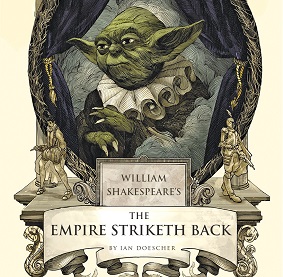
THE-EMPIRE-STRIKETH-BACK-cover_283x277

Get thee once more to a Galaxy far, far away

Let me start by saying I’m a Star Wars fan. So much so that I waited until May 4th, Star Wars day to read Ian Doescher’s second installment of his William Shakespeare’s Star Wars series, The Empire Striketh Back. This like his first, William Shakespeare’s Star Wars, was sent to me by the good folks over at Librarything as part of their Early Reviewer’s program. Those who know me well also know I am a student of Shakespeare which is why I wanted to review the series. I absolutely loved the first one, but have some issues with the second.

First let me praise Doescher for not only attempting to adapt Shakespeare for modern audiences but also for his masterful ability to condense an action packed movie into a 163 page book. Doescher manages to capture the excitement of the movie and doesn’t miss a beat as he seamlessly moves from one scene to the next. His use of iambic pentameter in such a skilled manner should earn him praise from poetry fans. Doescher sticks mostly to modern language and rhythm, with a few well known Elizabethan terms thrown in for good measure. Young fans of Star Wars can follow this book without feeling overwhelmed by the poetic style of writing and old language.

One of the Doescher’s more cleaver tricks is giving voice to characters that had none in the movie. Take the Wampa who drags Luke off to his cave, as an example.

Pray know that I a wampa simple am,

And take no pleasure in my angry mood.

Though with great force this young one’s face I slam,

I prithee know I strike but for my food.

Doescher reminds his audience that even the lowest of creatures have feelings and that their actions are not always done with malice. Wampa’s gotta eat too! We hear from the monster, Exogor, the worm like creature whose mouth the Millennium Falcon accidently flies into. He laments that his meal has fled and goes into a soliloquy about being alone.

Yet for all of the fun Doescher brings to the mash-up, I cannot help but be disappointed in his use of Shakespeare’s work and the lack of ties to the plays. What no Henry IV or V battle scene speech?

The back and forth banter between Han and Leia is very much like that we hear between Beatrice and Benedict, yet none of the other characters are nods to Shakespeare. The asides by Han and Leia got a little tiring. Each talk about how they feel about the other. Yeah, we get it. They like each other but are too proud to show it. Star Wars fans already know this and don’t need constant reminders.

Doescher in his Afterward likens The Empire Strikes Back to a Shakespearian inspired tragedy, yet goes on to compare Luke with Oedipus. “Oedipus who learns only too late that his mother is his wife, tears out his eyes after she hangs himself. Luke discovers that Darth Vader is his father just after losing a hand-close enough, right?” No, wrong! How about this? Hamlet is told Claudius killed his father, just like Luke is told Vader killed his father. Luke finds out Vader is his father, just as Hamlet finds out Claudius is his step-father! Both spend a lot of time brooding over these turn of events. Come on Doescher, this was a no brainer. Doescher even has Luke questioning his place in the world and the use of war, yet never do we hear any hint of a doubting Hamlet.

Doescher says he decided to have Yoda speak in haikus. He tells his readers this in the afterwards. I would have liked to have known this before I started reading. Yoda’s odd speech pattern baffled me, and jerked me out of the story. I spent too much time trying to figure out what Doescher was doing. Remember, Doescher is the one who is claiming to do a mash-up of Shakespeare and Star Wars. Sadly, Shakespeare just doesn’t show up enough to make this a true mash-up. Unlike the first book, the references are few and far between. When he does use Shakespeare the lines feel forced, as if Doescher had just remembered he had to add them in.

If flurries be the food of quests, snow on.

The oddest mix of Shakespeare and Star Wars comes right after Vader has entered. He has a conversation with a few commanders and after they leave he unexpectedly goes into a soliloquy that originally was Shylock’s speech, spoken in frustration for his abuse by the Christians.

Hath not a Sith eyes?

If you prick us, do we not bleed? If you

Blast us. Shall we not injur’d be?

While this may delight some Star Wars fans, it had me puzzled. Sure, he may feel abused by the rebels, but it is he who is embarking on a plan to wipe them all out. This famous speech feels forced and out of context to the scene before and after. For true students of Shakespeare Doescher’s use of the Bard’s words may fall flat.

Doescher does remind his readers that above all else this book is written to be fun. And for all the faults I have pointed out, it really is fun. But, if this is a series titled William Shakespeare’s Star Wars, then more care should be given to make proper use of the Bard’s world. To quote Hamlet,”O God, I could be bounded in a nutshell and count myself a king of infinite space…” Come on Doescher, Shakespeare’s world is infinite space, set in a time, long, long ago. Use it, and use it well.

Amazing Waste

Repurposing Food and Reducing Waste

measurestillformeasure

Shakespeare, Classics, Theatre, Thoughts

Nerd Cactus

Quirky Intellect for the Discerning Nerd

Sillyverse

Stories of magic and mystery

Commonplace Fun Facts

Mind-Blowing Facts You Didn’t Know

Fictionophile

Fiction reviews, Bookblogger, Fiction book reviews, books, crime fiction, author interviews, mystery series, cover, love, bookish thoughts...

Patrick W. Marsh

monsters, monsters, everywhere

Shakespeare for Kids Books

Opening the door for kids to love Shakespeare and the classics

desperatelyseekingcymbeline

The 10-year Shakespeare New Year Resolution

Katzenworld

Welcome to the world of cats!

booksandopinions.com

The Book Reviews You Can Trust!

The Book Review Directory

For Readers and Writers

thelitcritguy

screams from the void

Author Adrienne Morris

Step Into the Past—Lose Yourself in the Story.

crafty theatre

ideas inspired by crafty characters

Critical Dispatches

Reports from my somewhat unusual life

The Nerd Nebula

The Nucleus of the Universe for all Nerd Hacks!