In the age of digital interaction, what counts as friendship?

Friendship-Sayings

While talking to my assistant yesterday I mentioned my love of podcasts. Without thinking I said, “I have two friends who host a thought provoking podcast on Sunday afternoons”. As soon as the words fell out of my mouth, I started to question my use of the term “friend”. I started to wonder, “are they my friends or are they acquaintances”? Why did I choose that word, and why was it so easy to think of them as friends even though we’ve never met face to face? In the age of superficial connections via social media, who is it that we can truly call our friend and who, an acquaintance?

Merriam Webster defines an acquaintance as:  Someone who is known but who is not a close friend The state of knowing someone in a personal or social way : the state of knowing someone as an acquaintance

This definition doesn’t seem to be at all helpful. If you know someone in a personal way, wouldn’t that person be your friend, or someone, because you personally know what she or he is like, is someone to avoid? We need a better definition.

Thanks to Facebook, we have come to loosely throw the term “friend” around when speaking about someone we’ve had even the slightest contact with. Before FB installed its Page feature, celebrities and authors looking to engage with their fans had to become “Friends” with them. Back in 2012 I became “friends” with Dr. Neil deGrasse Tyson and even had a one on one conversation with him, but in no way did that count as friendship. So what does?

Who is the friend and who is the acquaintance?

Take these two people as examples: one is someone with whom I am in almost daily contact with, even if it’s a quick note on her FB wall. We’ve been in contact for almost 9 years. In those 9 years we’ve managed an online book club together, wrote long personal e-mails (I owe her one) and have exchanged Christmas gifts. I can still recall the thrill of picking out books for her daughter’s 6th birthday. But for all of that, we’ve never met face to face. The other is someone that I went to school with. Someone I hung out with middle school (somewhere in my collection of pictures is one of us dancing at my 13th birthday party). Of course we lost contact after high school and it wasn’t until the invention of FB did we reconnect. I have no idea what his wife’s name is, or how long they’ve been married. Once in a while we post a comment on each other’s wall, and give the obligatory birthday greeting. Yet despite the fact that he and I went to school together and at one time had a personal relationship, I’d be hard pressed to say we are truly friends. He has become an acquaintance, while my online friend and I share a very close personal relationship.

The above example seems obvious, we are learning in large part thanks to the Internet, that real friendships can develop even if distance keeps us apart. But that doesn’t answer my original question, given that we can now connect with authors, podcasters, bloggers etc. Who is it that we can truly call our friend and who an acquaintance?  Have we’ve been conditioned to use this term as a catch all for our daily social interactions? What is the line between friendship and a casual acquaintance? Surly not everyone we interact with are true friends.

That last question was key to my understanding of why I called the two above mentioned podcasters my friends. I’ve subconsciously formed an idea of whom I call friend. We all have I’m sure. I even suspect we all have list of what makes up a friendship or at least a vague idea of such a list.

The more I pondered the term “friend” and how I use it, the more important this list seemed to be. So I sat down and wrote one out in order to answer my question and understand why I called two guys I’ve never met, friends. This is how I determine whom I feel comfortable calling friend. I was a little hesitant to share it, as I am sure there will be those reading it that don’t agree or may feel uncomfortable with my idea of friendship. Don’t worry, most of you will never be asked to help me move or get that frantic 2am call.

I once had a boyfriend tell me my internet relationships were not real. He's gone, but my online friends remain.
I once had a boyfriend tell me my internet relationships were not real. He’s gone, but my online friends remain.

You might be Sari’s friend, even though we’ve never met if:

We’ve stayed in contact for a long period of time, even if that contact has moved from one form of social media to another. We’ve shared our ups and downs and know as much, if not more, than the people in our daily lives.

You share personal pictures and stories on your FB wall and or blog and we talk about them, and we do this on a regular basis. I know about your family and your achievements and you know about mine. We cheer each other on and give sympathy when needed.

We feel comfortable posting possible unpopular opinions, knowing the other will not be offended because we both value honesty and differing points of view. And we do this quite often.

I am one of the few people that you will get back to right away. Whenever I e-mail or send a quick Tweet, you make sure to respond right away. We may not communicate often but when we do it is never shallow or impersonal.

Our conversations have moved beyond what brought us together in the first place. If we stay on one topic, then we are acquaintances who share similar tastes and worldviews.

In short, those I call friends know and value my opinions, take me for who I am and are comfortable being themselves around me. We share pieces of our lives, sometimes small, and sometimes more than we share with others. We may not be in constant contact, but when we do communicate it is always a good feeling. And that, I believe, is the cornerstone of all friendships, no matter the distance between us.

I count myself in nothing else so happy
As in a soul remembering my good friends.
William Shakespeare Richard II

If you have an idea or list of things that you use to determine friendship let us know. All comments are welcome.
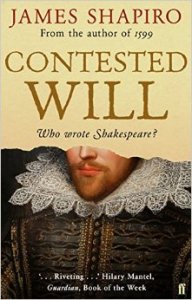
Contested Will or a look into why people deny Shakespeare

517jHQZPLjL._SY344_BO1,204,203,200_

By heaven, methinks it were an easy leap to pluck bright honor from the pale-faced moon, or dive into the bottom of the deep, where fathom-line could never touch the ground, and pluck up drowned honour by the locks. Henry IV Pt. I

If anyone is wiling to doubt on their authority, the history and existence of Christ, he must, in order to be consistent, be wiling to doubt on the same grounds, the history and existence of Shakespeare.

So begins a semi-satirical argument made in 1848 by Mosheim Schmucker in his book, Historical Doubts Respecting Shakespeare: Illustrating Infidel Objections Against the Bible (his publisher rejecting the shorter title of Oh Come on, seriously? because all great late 1800 book titles were required to be long and pretentious). Unfortunately for Schmucker, and to Shakespeare scholarship in general, his book was taken far too seriously.

The book was written as a response to another titled, The Life of Jesus, and the burgeoning “Higher Criticism” movement that inspired it. The phrase “Higher Criticism” described the study of the origins, date, composition, and transmission of the books of the Bible in order to separate fact from fiction. David Fredrick Strauss, one of the scholars who employed this method to the New Testament, came to the conclusion that there was no “supernatural, divine Christ, no miracles and no resurrection of the dead”. This did not sit well with the clergy (as one can easily imagine) and so Schumuker took it upon himself to write a response. The results were not what he had expected and sadly, we’ve been subjected to the 2011 movie Anonymous because of it.

To be Shakespeare or not to be Shakespeare. Allow me to take everything out of historical context while asking this question.

Schumuker, a historian and Lutheran pastor, decided to parody Strauss and his like by writing a book using the same arguments to determine if Shakespeare ever existed. Schumuker never doubted Shakespeare’s existence and assumed his readers would see the book for what it was intended to be; a satirical rebuttal to the argument that given the lack of historical data and contradictory stories surrounding Christ, we must conclude there was no Christ. He wanted his readers to see through Strauss’ argument using the “absence of evidence argument”. What ensued was not what he expected; it began the serious study of the authorship question that still rages today. Ironically, those seeking to question Shakespeare’s authorship used Schumuker’s book as their bible; using his arguments as talking points. Though the book is no longer regarded as the ultimate guide to the authorship questions, the arguments he presented are still in use today. Thanks to Schumuker and his obvious lack of satirical skills, the authorship question did not die a natural death. One could say he resurrected a question that was all but forgotten and gave it new life.

I found this story absolutely intriguing. It is one of several stories James Shapiro offer us in which we learn how and why the authorship question remains a topic of interest and debate. I learned that Mark Twain came to question Shakespeare as an author because in his later years he was convinced that all writing is consciously and subconsciously autobiographical. Twain was famous for his “truth” in fiction, but as he aged he began to believe that all writers expressed themselves in their works and that no one could write about things that they themselves had not experienced. I have to wonder if anyone pointed out to Twain that he was not a time traveler yet was able to write a lovely book on the subject.

A better-suited title for the book, Contested Will Who wrote Shakespeare? would’ve been Contested Will Why people deny Shakespeare, as this is what Shapiro offers us. It is the history of doubt and what led other wise intelligent scholars, writers, and armchair historians to question whether there ever was a playwright named William Shakespeare. I read it in one day as I could not put this book down. It is one of my favorite books regarding the study of Shakespeare.

I have to commend Shapiro for his even-handed style in which he presented these people and their stories. It could have been so easy for him to scoff and make fun of them, but instead he presents their cases in a respectful and very well researched manner. Yes, once in awhile he does ask a question or makes a remark but this on ensures that the book is lightheaded tone, rather than a dry academic read or catty argument against the Anti-Stratfordians.

Make no mistake, this book is about the authorship questions but it is much more; it is a fascinating look into historical scholarship and offers modern readers the chance to see the other side of literary debate. Who knew this all really started with one woman’s frustration with not being taken as a serious scholar and took off when a pastor overestimated his comedic writing skills? Thank you Mr. Shapiro for enlightening us as to why people deny Shakespeare.

Works Cited/ Referenced

American Psychology Association The psychologies of Mark Twain

William Shakespeare Henry IV part 1

James Shapiro Contested Will Who Wrote Shakespeare?

Amazing Waste

Repurposing Food and Reducing Waste

measurestillformeasure

Shakespeare, Classics, Theatre, Thoughts

Nerd Cactus

Quirky Intellect for the Discerning Nerd

Sillyverse

Stories of magic and mystery

Commonplace Fun Facts

Mind-Blowing Facts You Didn’t Know

Fictionophile

Fiction reviews, Bookblogger, Fiction book reviews, books, crime fiction, author interviews, mystery series, cover, love, bookish thoughts...

Patrick W. Marsh

monsters, monsters, everywhere

Shakespeare for Kids Books

Opening the door for kids to love Shakespeare and the classics

desperatelyseekingcymbeline

The 10-year Shakespeare New Year Resolution

Katzenworld

Welcome to the world of cats!

booksandopinions.com

The Book Reviews You Can Trust!

The Book Review Directory

For Readers and Writers

thelitcritguy

screams from the void

Author Adrienne Morris

Step Into the Past—Lose Yourself in the Story.

crafty theatre

ideas inspired by crafty characters

Critical Dispatches

Reports from my somewhat unusual life

The Nerd Nebula

The Nucleus of the Universe for all Nerd Hacks!