Sari’s 37 silly reasons to Celebrate Shakespeare

A-vanitas-still-life-with-a-candle,-an-inkwell,-a-quill-pen,-a-skull-and-books

As we celebrated last year’s 450th anniversary of Shakespeare’s birth, I presented you with a few fun lists. I wasn’t sure I wanted to repeat myself this year; I thought one would be enough, but after reading Shakespeare’s Globe’s 37 Reasons to Celebrate Shakespeare , I was inspired to come up with one more. While many of the Globe’s reason’s are serious, I decided to come up with a list of 37 silly reasons to celebrate Shakespeare; some not as obvious as others. I’d love to see more, so I challenge my fellow Shakespeare bloggers to come up with their own 37 reasons to Celebrate Shakespeare.

images-3

Sari’s 37 silly reasons to Celebrate Shakespeare
  • We wouldn’t have anything to compare our lovers to.
  • He makes us think about the hard questions in life. Does a rose by any other name actually smell as sweet?
  • The only western playwright to use the word honorificabilitudinitatibus correctly in a sentence.
  • To be or not to be is still the question
  • He gave us countless blathering foolish wits and conversely, some loquacious witty fools.
  • He makes shipwrecks seem like a lot of fun.
  • He gave us daddy issues way before Freud invented mommy issues.
  • He left us with some great names. Let’s be honest; we are all a little disappointed that we left college without making friends with cool last names like Rosencrantz and Guildenstern.
  • He gave Kenneth Branagh a purpose in life.
  • He reminds us to always treat a stranger as if he were our brother.
  • 400 years later we still don’t have a better sonnet writer.
  • 400 years later the only people who know the difference between a poem and a sonnet are poets and Shakespeare fanatics.
  • Three words: Gnome & Juliet.
  • Best stage direction ever: exit, pursued by a bear.
  • He gave us teenage angst, extreme teenage angst.
  • We all now know that when presented with three boxes, always take the least desirable looking one.
  • He legitimized the breaking of the fourth wall.
  • Two words: Folger Library.
  • He gave us some of the world’s best female characters and one of the world’s worst male characters (I’m looking at you Iago).
  • He gave us the best lines in all of the theater. Oh, we argue over which ones they are, but not who wrote them.
  • He taught us that geography doesn’t really matter.
  • He taught us never to give our children their inheritance before we die.
  • A lot of us wouldn’t know what to do without our Sundays. #ShakespearSunday.
  • Without him, errors would not be so comical.
  • Quoting Shakespeare will impress your date, even if they don’t know the hell you are talking about.
  • Without him would anyone really care about the Ides of March?
  • Hamlet didn’t need eyeliner to be Goth.
  • Let’s face it, a lot of people went into acting just so they could speak the speech.
  • Let’s face it, only real Shakespeare fans will get #29.
  • Without him, Harold Bloom would still be wondering who invented the human.
  • Without him no amount of explaining would make the skull on your bookshelf any less creepy.
  • He gave us much ado about everything.
  • He taught us that it’s best to avoid talking to that small group of women we encounter on the road.
  • He taught us excessive hand washing might be a sign of more than just OCD.
  • College students would be agonizing over Chaucer right now.
  • One word; Dogberry.
  • He added over 1700 new words to our collective vocabulary and enriched our language. A better speech was never spoke before (Love’s Labour’s Lost).


He would drown the stage with tears
And cleave the general ear with horrid speech;
Make mad the guilty and appal the free,
Confound the ignorant, and amaze indeed
The very faculties of eyes and ears.
(Hamlet)

Synchronicity with Shakespeare

Do you believe in synchronicity? It’s a term attributed to Carl Jung, in which there appears to be an “acausal connection of two or more psycho-physic phenomena”. Or in other words, a coincidence that occurs beyond what could be explained as a normal random event. This is also known as a meaningful coincidence. But most coincidences are random events that tie two or more things together or at least appear to. For example, you might be thinking about ice cream as you are watching T.V. only to find that during the next commercial break there’s an ad for Håågen Das. This may feel like a meaningful coincidence, especially if you take the ad to be a sign that you deserve the ice cream, but it’s not. A commercial that features ice cream is not odd or rare. Thinking about eating while watching T.V. is normal; there are so many food related commercials that it would be odd if you didn’t think about it now and again.

Normally I am a little skeptical when it comes to meaningful coincidences, but I’ve had several occur in my life so I am also open to the possibility that, in the words of my friend Micah, high strangeness can occur. It hasn’t happened for quite a while, at least not until last night. And oh boy, did it happen last night!

The impetus that led to last night’s high strangeness actually started about two month ago when I was talking about Shakespeare. A question was asked, “What makes him stand out among his peers?” and I had to admit I’d hadn’t read enough of his peers to make a solid case, other than to say, we don’t much remember them, so his writing was obviously better. I wasn’t completely happy with that answer so it occurred to me that it would be useful to have some type of collection of plays and or stories by some of his contemporaries. I have some of Marlow’s work, but not Ben Johnson or John Fletcher.

It just so happened that about the time I started looking for a possible collection of early 16th century plays, one of my fellow Shakespeare scholars Tweeted about a book he found in a used bookshop. The book is volume two (I think) in a series titled English Drama, this volume, 1580-1642. Shakespeare just happens to sit right in the middle of this time frame. This was exactly what I was looking for.

This Tweet is what I could call a lucky coincidence. Since most of the people I follow on Twitter are Shakespeare geeks and scholars it is no real surprise that one of them would eventually share a find like this. And who knows, even if I hadn’t been looking for a book like this, his Tweet might have prompted me to start thinking about my gap in literary knowledge of 16th century playwrights.

So we can agree that this was just a random event that just happened to coincide with my search for this type of collection. But here is where it all starts.

First, I have to explain who is not in this book. As the editors admit, “Due to constraints only five percent of ‘Elizabethan’ work is presented within these pages”. Shakespeare is not included because, and again in the words of the editors, “Ha, ha, ha, that’s funny. Everyone already has a collection of Shakespeare somewhere in their house!” Okay, I am paraphrasing, but the first volume does suggest that the hope of this collection would be to present other, less well remembered authors and playwrights, and that it would be redundant to include someone who is already widely available.

So, and I cannot emphases this enough, this volume in theory, had nothing to do with Shakespeare or his writing. The only connection it had was in my own head; I wanted it as a tool for my writing and lecturing.

Ah Amazon. Is there nothing that cannot be found on this site? It just so happened that several used bookstores connected to Amazon had copies for sale. I picked a seller with a 100% customer satisfaction rate who had what was described as a gently used copy. Just a random seller, with a good deal for me. No high strangeness here, right?

The book was due to arrive in April but, and this must be part of the 100% satisfaction, it came last night. This is what it looks like. Oh, and it weighs a ton. I’d hate to have to lift 10 percent of Elizabethan work.

IMG_0225

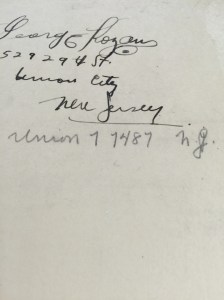
I first opened the inside cover and saw this lovely inscription. I enjoy buying used books that have the original owner’s name in it. It makes me feel connected to them. It even has his street and city address. Now that, I’ve never seen before. If I didn’t believe the owner to be dead, I would almost have been tempted to write a letter of thanks for passing it on.

George Kazan 529 29th Street Garden City NJ (last line unclear)
George Kazan
529 29th Street
Garden City NJ
(last line unclear)

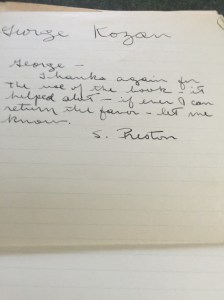
And here is where the high strangeness begins. When I flipped opened a random page to see just how sturdy this old book is, I found this. It is a note thanking the owner, George Kozan, for lending it out!

IMG_0228

George-

Thanks again for use of the book-it helped a lot-if every I can return the favor-let me know.

S. Preston

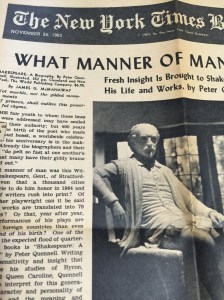
If this wasn’t odd enough, the note was placed on top of a newspaper article. I paused when I saw it. It was strange enough that I just happened to flip to the page that contained a note of thanks, but it also contained an old folded up newspaper clipping. Besides inscribed covers, I get a thrill out of finding stuff like old newspaper clippings in used books. Usually they aren’t useful but can be entertaining if they have ads or pictures of the latest fashion. I saw that this was a clipping was from the New York Times Book Review section. I unfolded it wondering what “new” book or books would be offered for review. What I saw as I opened it up stunned me, and for a second I think I stopped breathing. As dumb as this sounds, the thought, “someone is playing with me” did go through my mind as I looked at the clipping.

IMG_0232

Yes, of all the clippings to keep, of all the books to keep it in, and of all of the people who could have ended up with this book, I, who wanted it for research for my own book about Shakespeare, was holding a review about a book about Shakespeare, Shakespeare a Biography, by Peter Qunnell.

I didn’t go looking for Shakespeare, but somehow found him anyway. If I weren’t such a skeptic, I might think that the universe had just handed me a sign that pointed to me finishing my book, but that may be a little to woo for me. On the other hand, even skeptics need inspiration so I’m going to frame the clipping and put it in my office. It can’t hurt.

Synchronicity my friends, synchronicity.

Amazing Waste

Repurposing Food and Reducing Waste

measurestillformeasure

Shakespeare, Classics, Theatre, Thoughts

Nerd Cactus

Quirky Intellect for the Discerning Nerd

Sillyverse

Stories of magic and mystery

Commonplace Fun Facts

Mind-Blowing Facts You Didn’t Know

Fictionophile

Fiction reviews, Bookblogger, Fiction book reviews, books, crime fiction, author interviews, mystery series, cover, love, bookish thoughts...

Patrick W. Marsh

monsters, monsters, everywhere

Shakespeare for Kids Books

Opening the door for kids to love Shakespeare and the classics

desperatelyseekingcymbeline

The 10-year Shakespeare New Year Resolution

Katzenworld

Welcome to the world of cats!

booksandopinions.com

The Book Reviews You Can Trust!

The Book Review Directory

For Readers and Writers

thelitcritguy

screams from the void

Author Adrienne Morris

Step Into the Past—Lose Yourself in the Story.

crafty theatre

ideas inspired by crafty characters

Critical Dispatches

Reports from my somewhat unusual life

The Nerd Nebula

The Nucleus of the Universe for all Nerd Hacks!