6 things you may not know about books

shakespeare bookstore_et_co_thumb


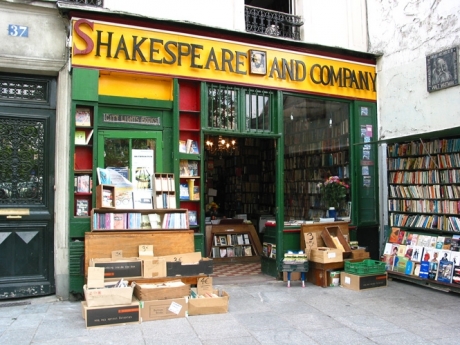
This afternoon while cleaning out old photo folders on my computer I came across this picture. I remember seeing it last year and wrongly assumed it was in England. I put it on my list of places to visit when I arrive in the U.K. and was bummed to find out it is actually in Paris.

Supposedly this is the most famous bookshop in the world. This is because of the high number of visitors it receives annually due to its name and its original owner Sylvia Beach having published Joyce’s Ulysses.

As I sat and contemplated the quaint colorful bookstore I wondered what kind of books I would find in it and oddly-though not real odd to book lovers-what it would smell like? Would it smell like an old musty building or would the smells from the   nearest French bakery have visitors wanting to eat the books?

All this book  pondering took me down a rabbit hole of book related questions. I learned that there are debates going on over the world’s longest and largest books and that some people are willing to spend small fortunes for a chance to own rare books. From all of this, I give you

6 things you may not know about books

The World’s Largest Book(S)
klencke_atlas_thumb

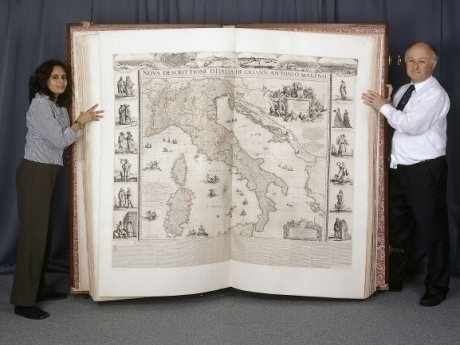
Up until 2012, The Klencke Atlas was acknowledged as the world’s largest book, measuring 1,75 meters long and 1,90 meters wide. It takes six people to lift it and two to open it.  Johan Maurits made The Klencke Atlas, which Amsterdam merchant Johannes Klencke presented to Charles II of England upon the king’s restoration to the throne in 1660.The book consists of 37 printed maps encapsulating the geographic and historical knowledge of the time. It is housed at the British museum. In 2012 the book’s classification changed so now it’s the world’s largest atlas.

According the 2012 edition of The Guinness World Records website, the largest book on record now is This is the Prophet Mohamed. The book purports to measure 5 m x 8.06 m and is said to weigh approximately 1500 kg (3,306 lb). The book is a compilation of stories highlighting the achievements of Mohamed and the Islamic influence. All this is according to the Guinness website. I cannot find any other mention of this book. Oddly the one and only picture of this book is not available for copy.  http://www.guinnessworldrecords.com/records-1000/largest-book/

The World’s Smallest Book
smallest book

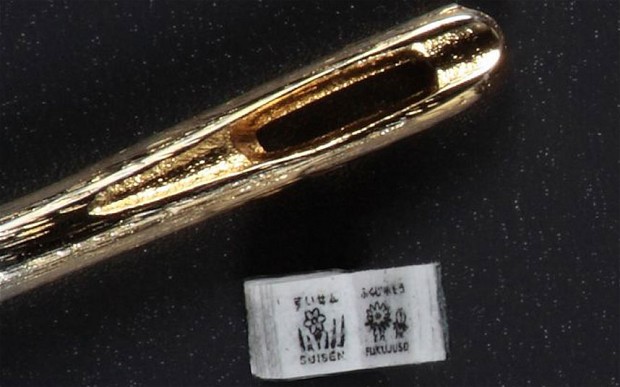
According the 2013 edition of The Guinness World Records website, the smallest book on records is entitled Flowers of the Four Seasons. The book measures 0.74 x 0.75mm. The book is sold as a set that includes an enlarged version and a magnifying glass. Not many who saw it at the Tokyo Printing Museum in 2012 were impressed. Only 149 copies sold.

World’s Longest Book.

remembrance-of-things-past

Now this was interesting research. I wanted to find the longest single volume book on record but found no real consensus on a particular title.  Some arguments held the position that it is world length that counts, while for others it came down to character spacing.

Some argue L. Ron Hubbard’s Mission Earth series was originally intended to be one novel, and by word count (1.2 million) would make it the longest book. But because crazy Mr. Hubbard never said it was one book the title remains with Proust and his 13-volume masterpiece A la recherche du temps, translated as Remembrance of Things Past.  The book contains 9,606,000 characters.

Who Houses the Most Books?

jefferson1

The Library of Congress is the largest library in the world, with more than 155.3 million items on approximately 838 miles of bookshelves. The collections include more than 35 million books and other print materials. Now I know where I want to spend my next vacation! I hope the chairs are overstuffed in well lit corners.

He Bought it for How Much?

Codex-Leicester

The Codex Leicester by Leonardo da Vinci was bought by Bill Gates for 30.8 million in 1994. The book is actually a 72-page document icontaining collections of scientific writings. The journal covers theories on astronomy, water, rock, air, the moon and the heavens.

The Book with the Oddest Origin Story
Devil Codex

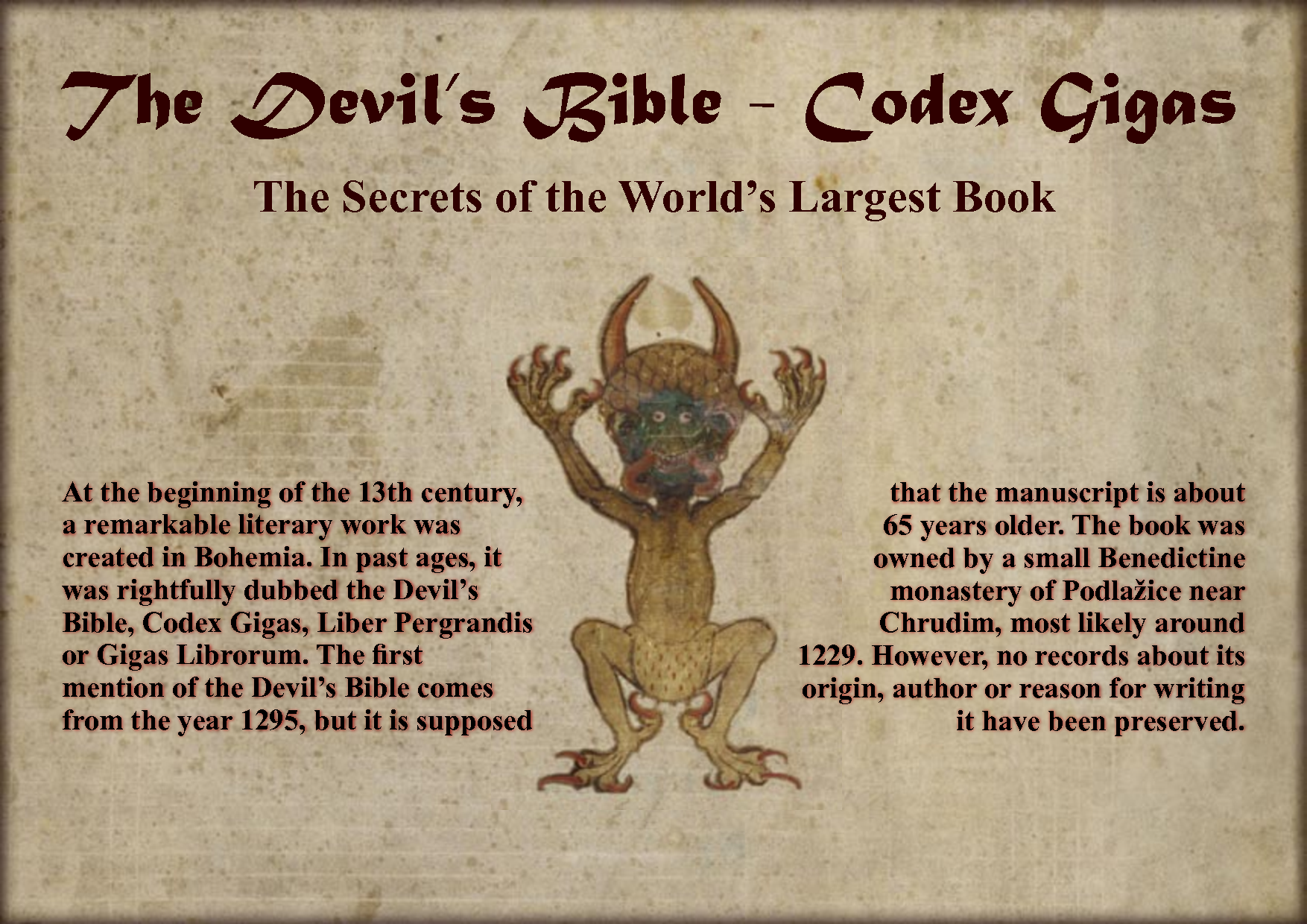
The Codex Gigas (giant book) or Devil’s Bible now housed at the National Library in Stockholm is famous for two features. First, it is reputed to be the biggest surviving European manuscript. Secondly, it contains a large, full page portrait of the Devil.

Legend says that in 1295 in what is now the Czech Republic an arrogant scribe or monk (take your pick) was to be punished for his sins. He begged to be allowed to create in one single night a book that would glorify the monastery forever. Knowing he could not accomplish the task he sold his soul to the devil. By morning this large volume included the Bible, Jewish history, universal and medical knowledge and local history. The front cover and middle section both contain the same drawing of the Devil. What became of the scribe is never mentioned.

The timing of the legend is unclear but we do know it was told in the middle ages. Oddly, National Geographic did some testing on the book and found that there was only one type of ink used, made from crushed insect nests. The style and font of the calligraphy is consistent throughout, leading the investigators to believe that the manuscript is the work of one scribe rather than many.

And now you know 5 new things about books

The Gospel of VALIS

Not too long ago I dated a man who asked “why do you spend so much time on the internet? You do realize you don’t know these people”. Well it turns out it was him who I did not know. When he said “I love you” what he really was saying was,” I like what I’m getting out of this relationship”. Once he had to put some effort into it he was gone.

I agree we don’t always know other people, but I will argue there are different degrees of knowing someone. Sharing ideas and reading other people’s work is a way to get to know someone else. Sadly, no I would not know many of you if we passed on the street, but I know you enough to want to spend time reading your work and joking with you on Twitter. I consider you my friends. So with that in mind I’m sharing a piece of me.This is my way of saying thank you for being there when I called out for encouragement.

This is a short essay I wrote for class. The class is titled “Literature and Religious Imagination”. This is the first graduate class in which the professor has asked us for short concise essays. I am not sure what I am mastering in this class other than the skill of brevity.

For those of you unfamiliar with Philip K Dick, he was a science fiction writer, whose best known for Do Androids Dream of Electric Sheep? The book is the basis for the movie Blade Runner. Dick wrote VALIS at at time in his life when he was suffering from a self diagnosed mental break-down. VALIS is the first in a series of books in which Dick explores religious ideas and fuses them with self confessions. As much as I enjoyed the book, and recommend it, I must confess, I felt he did go off the deep end in this book. The core premise is what kept me up at night; what if our creator was insane?

philip_k_dick_valis_ltdfull

The Gospel of VALIS

            To paraphrase reverend Horselover Fat, “The universe is the physical manifestation of an irrational mind”. Fat is not too far off from what many philosophers and scientist have been arguing for thousands of years, though he is the first to say irrational mind. Plato believed the universe and everything in it is the physical manifestation of perfect nonphysical “forms”. That everything we see and experience are imperfect copies of perfect metaphysical forms.  Yet, what if the physical is imperfect because the non-physical is also imperfect? Could we not argue that we are imperfect because there is no other way to be? Plato was wrong to call his forms perfect, because perfect cannot make imperfect. If it did, it would no longer be perfect.

Professor Paul Davies argues in his book The mind of God that, “the universe is a kind of gigantic computer”.(16). He goes on to argue that the universe is no minor byproduct of mindless forces. That it works as if it is a mind. Davies does not believe that a god created the universe for his pleasure, rather the universe is the mind of what we in the West call God and what the Hindus call Brahman. Hindu philosophy says Brahman is the universe and everything in it are bits and pieces of Brahman. Taken as a whole, everything makes up Brahman.

Professor Amit Goswami argues in his book The Self-Aware Universe, how consciousness creates the material world, that consciousness affects how atoms behave. They act rational because a rational consciousness controls them. Quantum physics tells us atoms and partials do not always act rational. Could this be because the consciousness that controls them is irrational? This could explain the odd behavior of quantum mechanics.

The reverend Horselover Fat, I call him reverend because he shares his new religion with anyone who will listen, believes that the universe is made up of living information able to replicate itself. “Replicating not through information, information as information.”(225) Fat argues that atoms are living information that come together to create the universe. He believes Plato’s forms and the Greek Logos are living information, or as Professor Goswami would say “consciousness”. Because Fat considers himself and everyone around him crazy, he goes to say, “A streak of the irrational permeated the entire universe, all the way of up to God.”(201). He believes that “God” or the “Ultimate Mind” suffered a terrible loss and that “From loss and grief the mind has become deranged. Therefore we, as part of the universe are partly deranged.”(201) We need to keep in mind it is Fat who suffered a terrible loss, and from this loss came his revelations and new found religious beliefs. Even so, could he be on to something? Let us look at his idea through two viewpoints; that of religion and science. Let us argue his points for him.

Let us suppose the universe is the physical manifestation of a mind so advanced that its very thoughts became living information; that all matter is made up of this information. We will call this mind God. If our supposition were right, this would explain why we humans are irrational beings and why we cannot get along. Our emotions are irrational! We act as we are, irrational beings living in an irrational universe. It is hard for many to believe a perfect mind would create such irrational beings yet this is what we are told. This creator, if we are to believe the stories, at times is irrational. He places the Tree of Knowledge on the Garden of Eden then tells his creations no to eat from it. If he did not want them to eat from it, why did he put it there in the first place? This is not rational. He gives his creations free will then punishes them with destruction for using free will. He tells a group of his creations they are now his chosen group and then instructs them to kill another group of his creations. None of this is rational behavior. If this is all playing out in the Ultimate Mind, we must assume the Ultimate mind is deranged just as Fat tells us.

If we assume the Big Bang was consciousness creating matter as Professor Goswami says or the universe is played out in a gigantic computer as Davies tells us, then we must ask, what kind of mind is this? The stars and planets are unstable; quantum mechanic laws vary depending on observation. Science believes quantum mechanics to be unstable. Is this because the mind or consciousness that created them is itself unstable? Could it be that we humans are irrational because of this unstable mind? Or as Fat thinks, are there some things that this mind cannot control? If so, it would be yet another argument for an unstable mind, one that cannot control its own physically manifested thoughts.

How often have we looked around and observed that the world is irrational? We pacify ourselves with the idea that we are imperfect creatures and have come up with rational explanations for our imperfections. We use medical science, psychology and sociology to justify our irrational behavior. Natural science explains our unstable planet, yet none of this adequately explains the deeper question of “why does this have to be so”? Why do we have to have mental illness, why do we have to have earthquakes? Why is the universe in all its glory so irrational and unstable? Reverend Horselover Fat is on to something when he preaches the universe is the physical manifestation of an irrational mind.

Works Cited

Davies, Paul. The Mind of God. New York: Touchstone, 2001.

Dick, Philip K. VALIS. New York: The Library of America, 2000.

Goswami, Amit. The Self-Aware Universe how consciousness creates the material world. New York: Putnam Books, 1993.

Amazing Waste

Repurposing Food and Reducing Waste

measurestillformeasure

Shakespeare, Classics, Theatre, Thoughts

Nerd Cactus

Quirky Intellect for the Discerning Nerd

Sillyverse

Stories of magic and mystery

Commonplace Fun Facts

Mind-Blowing Facts You Didn’t Know

Fictionophile

Fiction reviews, Bookblogger, Fiction book reviews, books, crime fiction, author interviews, mystery series, cover, love, bookish thoughts...

Patrick W. Marsh

monsters, monsters, everywhere

Shakespeare for Kids Books

Opening the door for kids to love Shakespeare and the classics

desperatelyseekingcymbeline

The 10-year Shakespeare New Year Resolution

Katzenworld

Welcome to the world of cats!

booksandopinions.com

The Book Reviews You Can Trust!

The Book Review Directory

For Readers and Writers

thelitcritguy

screams from the void

Author Adrienne Morris

Step Into the Past—Lose Yourself in the Story.

crafty theatre

ideas inspired by crafty characters

Critical Dispatches

Reports from my somewhat unusual life

The Nerd Nebula

The Nucleus of the Universe for all Nerd Hacks!