Shakespeare & Star Wars? Not so much

THE-EMPIRE-STRIKETH-BACK-cover_283x277

Get thee once more to a Galaxy far, far away

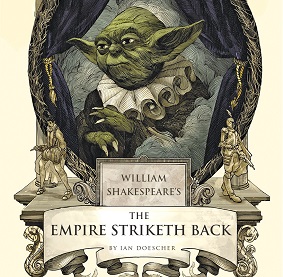
Let me start by saying I’m a Star Wars fan. So much so that I waited until May 4th, Star Wars day to read Ian Doescher’s second installment of his William Shakespeare’s Star Wars series, The Empire Striketh Back. This like his first, William Shakespeare’s Star Wars, was sent to me by the good folks over at Librarything as part of their Early Reviewer’s program. Those who know me well also know I am a student of Shakespeare which is why I wanted to review the series. I absolutely loved the first one, but have some issues with the second.

First let me praise Doescher for not only attempting to adapt Shakespeare for modern audiences but also for his masterful ability to condense an action packed movie into a 163 page book. Doescher manages to capture the excitement of the movie and doesn’t miss a beat as he seamlessly moves from one scene to the next. His use of iambic pentameter in such a skilled manner should earn him praise from poetry fans. Doescher sticks mostly to modern language and rhythm, with a few well known Elizabethan terms thrown in for good measure. Young fans of Star Wars can follow this book without feeling overwhelmed by the poetic style of writing and old language.

One of the Doescher’s more cleaver tricks is giving voice to characters that had none in the movie. Take the Wampa who drags Luke off to his cave, as an example.

Pray know that I a wampa simple am,

And take no pleasure in my angry mood.

Though with great force this young one’s face I slam,

I prithee know I strike but for my food.

Doescher reminds his audience that even the lowest of creatures have feelings and that their actions are not always done with malice. Wampa’s gotta eat too! We hear from the monster, Exogor, the worm like creature whose mouth the Millennium Falcon accidently flies into. He laments that his meal has fled and goes into a soliloquy about being alone.

Yet for all of the fun Doescher brings to the mash-up, I cannot help but be disappointed in his use of Shakespeare’s work and the lack of ties to the plays. What no Henry IV or V battle scene speech?

The back and forth banter between Han and Leia is very much like that we hear between Beatrice and Benedict, yet none of the other characters are nods to Shakespeare. The asides by Han and Leia got a little tiring. Each talk about how they feel about the other. Yeah, we get it. They like each other but are too proud to show it. Star Wars fans already know this and don’t need constant reminders.

Doescher in his Afterward likens The Empire Strikes Back to a Shakespearian inspired tragedy, yet goes on to compare Luke with Oedipus. “Oedipus who learns only too late that his mother is his wife, tears out his eyes after she hangs himself. Luke discovers that Darth Vader is his father just after losing a hand-close enough, right?” No, wrong! How about this? Hamlet is told Claudius killed his father, just like Luke is told Vader killed his father. Luke finds out Vader is his father, just as Hamlet finds out Claudius is his step-father! Both spend a lot of time brooding over these turn of events. Come on Doescher, this was a no brainer. Doescher even has Luke questioning his place in the world and the use of war, yet never do we hear any hint of a doubting Hamlet.

Doescher says he decided to have Yoda speak in haikus. He tells his readers this in the afterwards. I would have liked to have known this before I started reading. Yoda’s odd speech pattern baffled me, and jerked me out of the story. I spent too much time trying to figure out what Doescher was doing. Remember, Doescher is the one who is claiming to do a mash-up of Shakespeare and Star Wars. Sadly, Shakespeare just doesn’t show up enough to make this a true mash-up. Unlike the first book, the references are few and far between. When he does use Shakespeare the lines feel forced, as if Doescher had just remembered he had to add them in.

If flurries be the food of quests, snow on.

The oddest mix of Shakespeare and Star Wars comes right after Vader has entered. He has a conversation with a few commanders and after they leave he unexpectedly goes into a soliloquy that originally was Shylock’s speech, spoken in frustration for his abuse by the Christians.

Hath not a Sith eyes?

If you prick us, do we not bleed? If you

Blast us. Shall we not injur’d be?

While this may delight some Star Wars fans, it had me puzzled. Sure, he may feel abused by the rebels, but it is he who is embarking on a plan to wipe them all out. This famous speech feels forced and out of context to the scene before and after. For true students of Shakespeare Doescher’s use of the Bard’s words may fall flat.

Doescher does remind his readers that above all else this book is written to be fun. And for all the faults I have pointed out, it really is fun. But, if this is a series titled William Shakespeare’s Star Wars, then more care should be given to make proper use of the Bard’s world. To quote Hamlet,”O God, I could be bounded in a nutshell and count myself a king of infinite space…” Come on Doescher, Shakespeare’s world is infinite space, set in a time, long, long ago. Use it, and use it well.

If it Wasn’t for Shakespeare…Lists!

shakespeare-birthday_1397451905

Today we celebrate Shakespeare’s 450th birthday. We do this even though historians are not quite sure this is his date of birth. What we do know is that he was baptized on April 26, 1564. Normally newborns were baptized three days after being born. He died on April 23, 1616, so April 23 is dedicated to the Bard.  And what better way to celebrate his work than with lists?

Polonius asked Hamlet, “What do you read, my lord? Hamlet replies “Words, words, words.

You my dear readers are going to read lists lists lists!

Harold Bloom, the great philosopher and Shakespearean critic, once said, “Shakespeare invented the human”. I would not go so far, but I would say that Shakespeare invented how we looks at the human condition. His characters are mirrors in which we can all look into and see a part of ourselves. But, be careful how you judge his work. Bloom reminds us, “How you view Shakespeare’s characters may say more about you than it does about him”.

Here is a quick list of some of his more famous humans:

Hamlet:

Hamlet has been called the man who could not make up his mind. He is tasked with avenging his father’s death, yet, while having no qualms about killing his traitorous friends, and lashing out with a sword in a murderous rage, he hesitates when it comes to killing Claudius. In act 3, scene 3, Hamlet comes across Claudius as he is praying. Claudius is alone and unarmed. Hamlet says, Now might I do it pat, now he is praying; And now I’ll do’t. And so he goes to heaven; And so am I revenged. That would be scann’d: A villain kills my father; and for that, I, his sole son, do this same villain send to heaven. O, this is hire and salary, not revenge. Hamlet realizes that by murdering Claudius while his uncle prays, his soul may find its way to heaven. This is not what Hamlet wants, yet it is the only opportunity Hamlet will have to dispatch his uncle. Because he hesitates, tragedy ensues. Hamlet sees and speaks to his father’s ghost who informs him of Claudius’ betrayal. Of how Claudius killed him, seduced his widow and stole the crown. The crown that is rightfully Hamlet’s. Yet even as he witness to his uncle’s usurpation, Hamlet needs more proof before he will act. In Act 2, scene 2 Hamlet comes up with a plan that will help him discover the truth. Murder has no tongue, but miraculously it still finds a way to speak. I’ll have these actors perform something like my father’s murder in front of my uncle. I’ll watch my uncle. I’ll probe his conscience and see if he flinches. If he becomes pale, I know what to do. The ghost I saw may be the devil, and the devil has the power to assume a pleasing disguise, and so he may be taking advantage of my weakness and sadness to bring about my damnation. I need better evidence than the ghost to work with. The play’s the thing to uncover the conscience of the king.

Hamlet doubts his own existence, and wonders, what’s the use of it all? He is hesitant when it comes to suicide. He cannot decide whether this is a good idea any more than he can decide if killing Claudius is the right thing to do.

To be, or not to be? That is the question—

Whether ’tis nobler in the mind to suffer

The slings and arrows of outrageous fortune,

Or to take arms against a sea of troubles,

And, by opposing, end them? To die, to sleep—

No more—and by a sleep to say we end

The heartache and the thousand natural shocks

That flesh is heir to—’tis a consummation

Devoutly to be wished! To die, to sleep.

To sleep, perchance to dream—ay, there’s the rub,

For in that sleep of death what dreams may come

When we have shuffled off this mortal coil,

Must give us pause. There’s the respect

That makes calamity of so long life.

For who would bear the whips and scorns of time,

Th’ oppressor’s wrong, the proud man’s contumely,

The pangs of despised love, the law’s delay,

The insolence of office, and the spurns

That patient merit of th’ unworthy takes,

When he himself might his quietus make

With a bare bodkin? Who would fardels bear,

To grunt and sweat under a weary life,

But that the dread of something after death,

The undiscovered country from whose bourn

No traveler returns, puzzles the will

And makes us rather bear those ills we have

Than fly to others that we know not of?

Thus conscience does make cowards of us all,

And thus the native hue of resolution

Is sicklied o’er with the pale cast of thought,

And enterprises of great pith and moment

With this regard their currents turn awry,

And lose the name of action.—Soft you now,

The fair Ophelia!—Nymph, in thy orisons

Be all my sins remembered. (3.1)

In the end all of his doubts just give Claudius time to plan Hamlet’s death. Every major character dies because Hamlet cannot make up his mind. He is so busy second guessing every move he misses major opportunities. In this we can see that often we too are Hamlet. We may never contemplate killing someone, but how often have opportunities past us by because we cannot make up our minds? Sometimes we too feel we have no control over our lives and allow fate to dictate what happens to us.

Lady Macbeth:

Lady Macbeth wants more out of life than a mere drafty castle in a Scottish outpost. She and her husband plot to kill King Duncan and take the crown by force. After the deed is done she quickly regrets her actions. The horror of what they have done seeps into her conscious like the king’s blood seeping onto the floor. Yet who would have thought the old man to have had so much blood in him (Act 5 -1). She begins to sleep walk and tries in vain to wash the blood from her hands. Out damn spot. Out I say! (Act 5-1)

She cannot live with what they have done and takes her life. I first read about Lady Macbeth in high school and the two lessons I took from her were:

  1. Be careful of what I wish for. I might not be able to handle it.
  2. Never do anything that will I will regret to the point of it taking control of my life.

It has been noted that the more successful we get, the more we lose sleep, the more we are unhappy with our lives. Too our horror we find that money and success do not equal happiness or contentment. We become like Lady Macbeth, and begin to regret all that we have done. She shows us the error of our ways when we substitute power for serenity.

Henry V

Henry V is a man of action, but it is his words that we hear (we never see the battle of Agincourt) that compel others to war and love. He talks his troops into war and he talks the French princess into falling in love with him. He is a reminder that words are just as powerful as action and that we should be wary of men with silver tongues.

Once more unto the breach, dear friends, once more;
Or close the wall up with our English dead!
In peace there’s nothing so becomes a man
As modest stillness and humility:
But when the blast of war blows in our ears,
Then imitate the action of the tiger;
Stiffen the sinews, summon up the blood,
Disguise fair nature with hard-favoured rage;
Then lend the eye a terrible aspect.
(3.1.1)

Shakespeare Invents words

Words Shakespeare gave us.

Shakespeare invented 1700 words.. Shakespeare has been credited for inventing single words that normally would have taken several to mean the same thing. I won’t list them all, but here is a partial list of words we use today:

  • auspicious
  • baseless
  • bloody
  • castigate
  • control (noun)
  • countless
  • courtship
  • critic
  • critical
  • dishearten
  • dislocate
  • dwindle
  • eventful
  • exposure
  • fitful
  • frugal
  • generous
  • gloomy
  • gnarled
  • hurry
  • impartial
  • lapse
  • laughable
  • misplaced
  • monumental
  • obscene
  • First folio

My personal favorite books on Shakespeare:

Shakespeare, the invention of the Human by Harold Bloom

Shakespeare’s World by DL Johanhak

Shakespeare by Michael Woods

How Shakespeare Changed Everything by Stephen Marche

A Readers guide to Shakespeare, by Joseph Rosenblum (I have been lucky enough to learn at this man’s feet. He is a master when it comes to understanding Shakespeare).

And thanks to No Sweat Shakespeare we can end with a list of fun Shakespeare facts:

Shakespeare is always referred to as an Elizabethan playwright, but as most of his most popular plays were written after Elizabeth’s death. He was actually more of a Jacobean writer. His later plays also show the distinct characteristics of Jacobean drama.

Almost four hundred years after Shakespeare’s death there are 157 million pages referring to him on Google. There are 132 million for God.

There are only two Shakespeare plays written entirely in verse: they are Richard II and King John. Many of the plays are a mix of verse and prose. The Merry Wives of Windsor is the only play that is almost entirely in prose.

Shakespeare’s shortest play, The Comedy of Errors is only a third of the length of his longest, Hamlet, which takes four hours to perform.

All of Uranus’ 27 satellites are named after Shakespearean characters.

Ophelia, Bianca, Cressida, Desdemona, Juliet, Portia, Rosalind, Cupid, Belinda, Perdita, Puck, Mab, Miranda, Ariel, Umbriel, Titania, Oberon, Francisco, Caliban, Stephano, Trinculo, Sycorax, Margaret, Prospero, Setebos, Ferdinand.

Among the 80 languages Shakespeare’s works have been translated into, the most obscure must be the constructed language of Star Trek’s Klingon. Hamlet and Much Ado about Nothing have both been translated as part of the Klingon Shakespeare Restoration Project by the Klingon Language Institute.

Happy Shakespeare Day!

Amazing Waste

Repurposing Food and Reducing Waste

measurestillformeasure

Shakespeare, Classics, Theatre, Thoughts

Nerd Cactus

Quirky Intellect for the Discerning Nerd

Sillyverse

Stories of magic and mystery

Commonplace Fun Facts

Mind-Blowing Facts You Didn’t Know

Fictionophile

Fiction reviews, Bookblogger, Fiction book reviews, books, crime fiction, author interviews, mystery series, cover, love, bookish thoughts...

Patrick W. Marsh

monsters, monsters, everywhere

Shakespeare for Kids Books

Opening the door for kids to love Shakespeare and the classics

desperatelyseekingcymbeline

The 10-year Shakespeare New Year Resolution

Katzenworld

Welcome to the world of cats!

booksandopinions.com

The Book Reviews You Can Trust!

The Book Review Directory

For Readers and Writers

thelitcritguy

screams from the void

Author Adrienne Morris

Step Into the Past—Lose Yourself in the Story.

crafty theatre

ideas inspired by crafty characters

Critical Dispatches

Reports from my somewhat unusual life

The Nerd Nebula

The Nucleus of the Universe for all Nerd Hacks!